
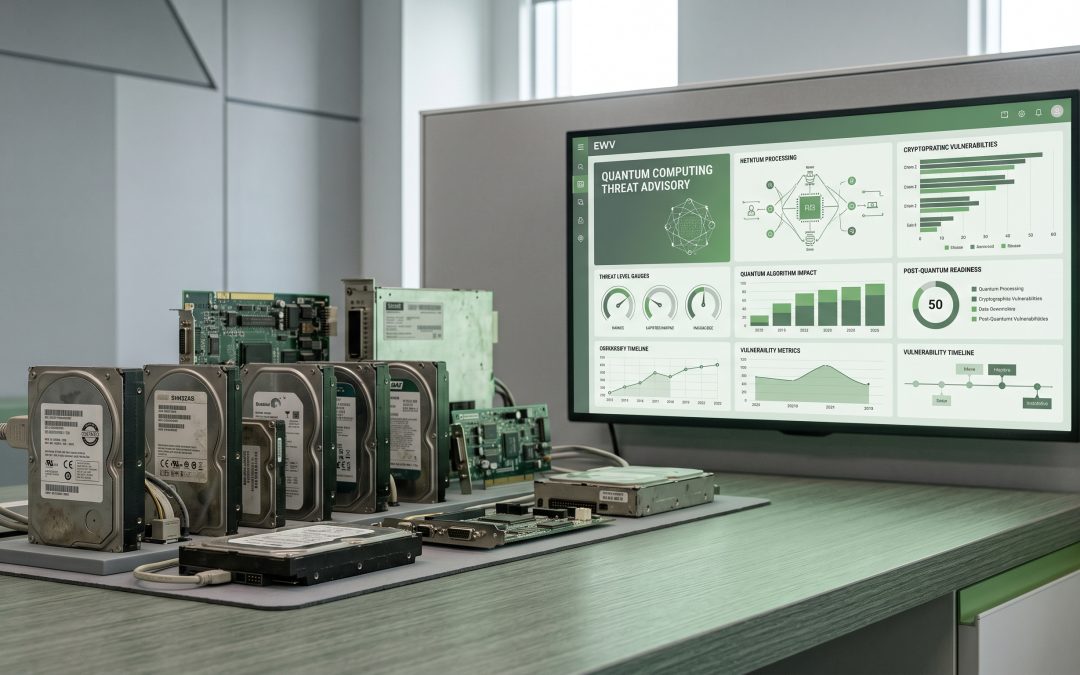
The Quantum Threat to Encrypted Data on Disposed Devices
Quantum computing is advancing from theoretical research toward practical reality. While large-scale, fault-tolerant quantum computers capable of breaking current encryption standards are still years away, their eventual arrival has profound implications for data that has already been disposed of on encrypted devices. Data that is secure today behind AES-256 or RSA encryption could become vulnerable tomorrow if the storage media it sits on still exists in recoverable form.
This creates a scenario that security professionals call “harvest now, decrypt later.” Sophisticated threat actors may be collecting encrypted data from disposed devices, discarded drives, and decommissioned infrastructure with the intention of decrypting it once quantum computing matures. For organisations that rely solely on encryption to protect data at disposal, this timeline shift changes the risk calculation significantly.
How Quantum Computing Threatens Current Encryption
Current encryption standards rely on mathematical problems that are extremely difficult for classical computers to solve. RSA encryption depends on the difficulty of factoring large prime numbers. Elliptic curve cryptography (ECC) depends on the discrete logarithm problem. These foundations have held firm against classical computing attacks for decades.
Quantum computers, using algorithms like Shor’s algorithm, can theoretically solve these mathematical problems exponentially faster than classical computers. A sufficiently powerful quantum computer could break RSA-2048 encryption in hours rather than the billions of years it would take a classical supercomputer. This would render the encryption on any surviving storage media effectively transparent.
Symmetric encryption algorithms like AES are more resistant to quantum attacks but not immune. Grover’s algorithm effectively halves the key strength of symmetric encryption against a quantum computer. AES-256 would offer roughly the equivalent of 128-bit security against a quantum attacker, which is still considered adequate, but AES-128, used in many older systems, would drop to an effective strength of 64 bits, which is potentially vulnerable.
The timeline for quantum computers capable of breaking real-world encryption is uncertain. Estimates from various research groups and intelligence agencies suggest somewhere between five and fifteen years for a cryptographically relevant quantum computer. However, the data disposed of today on encrypted drives does not have a shelf life. It persists on the physical media until the media is destroyed.
Implications for Data Destruction Practices
The quantum threat reinforces a fundamental principle of data destruction: encryption alone is not a substitute for physical or verified data destruction. Organisations that have relied on encrypting drives and then disposing of them without further sanitisation are creating a pool of potentially vulnerable data that grows with each disposal cycle.
This does not mean encryption is worthless at disposal. Far from it. Encryption remains an extremely valuable layer of protection, particularly for the immediate-term risk of data recovery from disposed devices. The quantum threat is a medium to long-term concern. But for organisations handling data with long-term sensitivity, such as government classified information, trade secrets with multi-decade value, health records, or defence-related data, the quantum timeline should influence disposal decisions today.
The most robust approach combines encryption with verified data destruction. Encrypt data throughout its lifecycle for operational security. When the device reaches end of life, perform NIST 800-88 compliant sanitisation to destroy the data regardless of its encryption status. For the most sensitive data, follow with physical destruction of the storage media to eliminate any possibility of future recovery.
Which Organisations Should Be Most Concerned
Not all data has a sensitivity lifespan that extends into the quantum era. A marketing department’s draft social media posts from 2024 will have no value to anyone by the time quantum decryption is available. The quantum threat is most relevant to organisations that handle data with enduring sensitivity.
Government and defence organisations handle classified information that may remain sensitive for decades. Intelligence agencies have long recognised the harvest-now-decrypt-later threat and are already adjusting their practices accordingly.
Healthcare organisations hold patient records that remain sensitive for the patient’s lifetime and potentially beyond. Genetic data, in particular, has permanent sensitivity as it does not change over time.
Financial institutions hold information about high-net-worth individuals, investment strategies, and transaction patterns that may retain value for extended periods.
Research institutions with long-term intellectual property, particularly in areas like pharmaceuticals, advanced materials, and energy technology, should consider the quantum timeline when disposing of research data.
Legal firms holding client communications protected by legal professional privilege generate data with indefinite sensitivity.
Post-Quantum Cryptography and Its Impact
The cryptography community is actively developing post-quantum encryption algorithms that will resist attacks from both classical and quantum computers. NIST has already standardised several post-quantum cryptographic algorithms, and the transition to these new standards is beginning across the technology industry.
However, post-quantum cryptography protects data going forward. It does not retroactively protect data that was encrypted with current algorithms and has already been disposed of. The data on drives that have already left your control, encrypted with today’s algorithms, remains vulnerable to future quantum attacks regardless of what new algorithms are deployed on future systems.
This makes the current transition period particularly important. Data being disposed of now, before post-quantum encryption is widely deployed, is encrypted with algorithms that will eventually be breakable. Ensuring that this data is physically destroyed rather than merely encrypted and released provides protection that is independent of the future cryptographic landscape.
Practical Steps for Quantum-Aware Disposal
For most organisations, the practical response to the quantum threat is to strengthen existing disposal practices rather than implement entirely new ones. Ensure that all device disposal includes verified data destruction, not just encryption. For devices containing data with long-term sensitivity, specify physical destruction of storage media as the standard.
Review your IT asset disposal policy to ensure it addresses the long-term risk profile of the data being disposed of, not just the immediate risk. Include data sensitivity classification as a factor in determining the appropriate level of destruction.
Work with your ITAD provider to confirm that their destruction methods provide quantum-resistant assurance. Physical destruction of storage media is inherently quantum-proof because the data no longer exists in any recoverable form. Verified overwrite sanitisation at NIST 800-88 Purge or Destroy levels provides similar assurance by making the original data physically unrecoverable regardless of the computational power applied to the recovery attempt.
The quantum era is coming. Ensuring that the data you dispose of today cannot be read by the computers of tomorrow is a matter of choosing destruction methods that are resilient against any future technology, not just today’s.
EWV helps Victorian businesses manage e-waste and IT asset disposal compliantly and sustainably — including collection, certified data destruction, and recycling. Contact us for a free quote.