
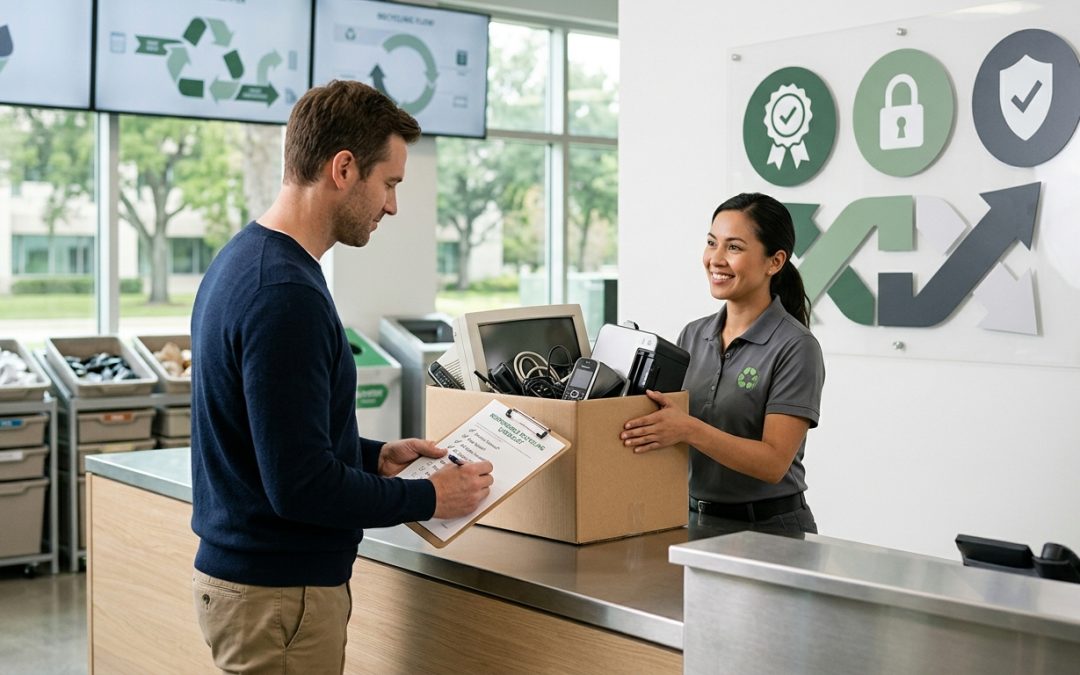
Don’t Just Hand Over Your Devices Blindly
Whether you’re recycling, donating, selling, or trading in your old electronics, there’s a moment of trust involved when you hand a device to someone else. That phone has your photos, passwords, and possibly banking details on it. That laptop has years of documents, browser history, and saved credentials. Asking the right questions before your devices change hands protects your data, your wallet, and the environment.
Most people give away or recycle old devices without asking a single question. That’s a risky approach. A few minutes of due diligence can make the difference between a responsible handover and a potential data breach or environmental violation.
Questions About Data Security
Data security should be your first concern, regardless of whether you’re recycling, donating, or selling. Every device with storage, even ones you might not think of, can contain recoverable personal data.
“What data destruction method do you use?” This is the most important question. A vague answer like “we wipe everything” isn’t good enough. You want to hear specifics: software-based wiping to a recognised standard like NIST 800-88, degaussing for magnetic media, or physical destruction (shredding) for devices that can’t be wiped. If they can’t name a specific method or standard, that’s a concern.
“Will I receive a certificate of data destruction?” Reputable recyclers and ITAD providers issue certificates confirming that data has been destroyed, typically including the device serial number, the method used, and the date. For businesses, this documentation may be legally required. For individuals, it provides peace of mind and a paper trail.
“Do you handle data destruction on-site or send devices elsewhere?” On-site destruction minimises the risk of data exposure during transit. If devices are transported to another facility for wiping, ask about how they’re secured during transport and what chain of custody documentation exists.
- Printers and multifunction devices (stored print jobs, address books, Wi-Fi credentials)
- Smart TVs and streaming sticks (login credentials for streaming services)
- Routers and modems (Wi-Fi passwords, connected device logs)
- Gaming consoles (payment card details, account credentials)
- Smart home hubs and voice assistants (recordings, home network access)
- Fitness trackers and smartwatches (health data, location history)
For a comprehensive overview of data destruction methods, see our comparison of hard drive destruction methods.
Questions About the Recycling Process
If your devices are going to a recycler, understanding what happens after handover is important. Responsible recycling looks very different from irresponsible dumping, and the right questions help you tell the difference.
“What happens to my devices after you collect them?” A good recycler will walk you through their process: intake and asset logging, data destruction, testing for reuse potential, dismantling and material sorting, and downstream processing. If they can’t or won’t explain the process, treat that as a warning sign.
“What percentage of materials do you actually recover?” Modern e-waste recycling facilities recover 90-95% of materials by weight from most devices. If a recycler claims much lower rates, they may be sending significant volumes to landfill. If they claim 100%, they’re probably not being truthful, as some material loss is normal in any recycling process.
“Do you export any materials overseas?” There’s nothing inherently wrong with exporting recovered materials to specialist processors. Precious metals recovered from circuit boards, for example, are often refined at specialist smelters overseas. The concern is when whole devices or unsorted e-waste is exported to countries with weaker environmental regulations for informal processing. Ask specifically whether whole devices or unprocessed e-waste leaves Australia.
“Are you licensed by the EPA?” In Australia, e-waste processing facilities generally need environmental licences from their state’s Environment Protection Authority. This licence means the facility has been inspected and meets minimum environmental and safety standards. Ask for the licence number so you can verify it independently.
Questions About Reuse and Refurbishment
If your devices still work, the most environmentally beneficial outcome is reuse rather than recycling. Extending a device’s life by even one year significantly reduces its overall environmental footprint.
“Do you test devices for reuse before recycling them?” The best e-waste operators have a triage process. Working devices get refurbished and resold or donated, extending their useful life. Only genuinely end-of-life equipment goes to material recycling. An operator that shreds everything without testing is wasting functional equipment.
“If my device is refurbished and resold, who benefits from the sale?” If you’re donating or recycling a working device, it’s reasonable to ask who profits from its resale. Some operators pass savings or revenue to charitable programs. Others keep the proceeds as part of their business model, which is also fine, but you should know which arrangement you’re entering into.
“Can I get a trade-in value or credit?” Many recyclers and retailers offer trade-in programs that give you credit or cash for functional devices. It’s worth asking rather than assuming your old device has no value. Even devices several years old can have residual value if they’re in working condition.
Questions When Selling Privately
Selling devices through marketplace platforms or to private buyers involves different considerations. Your responsibility for data security doesn’t end because you’re selling rather than recycling.
“Have I properly factory reset this device?” This one is a question for yourself. Before listing any device for sale, perform a complete factory reset and verify that your accounts, photos, messages, and other personal data are no longer accessible. Sign out of all accounts first, remove SIM cards and memory cards, and disable any device tracking or anti-theft features.
“Is the buyer asking for anything unusual?” Be cautious of buyers who want devices specifically without a factory reset, or who are overly interested in what data might be on the device. While this is uncommon, it does happen, and your data is worth more than the sale price of an old phone.
“Am I accurately describing the device’s condition?” Honest listings protect you from disputes and returns. Note any cosmetic damage, battery health, performance issues, or defects. Include the model number, storage capacity, and age. Honesty builds trust and leads to smoother transactions.
Questions When Donating
Donating electronics to charities or community organisations is a great option for functional devices. A few questions ensure your donation actually helps rather than creating a burden.
“Do you actually need this type of device?” Not all charities need all types of electronics. Some only want laptops or tablets for educational programs. Others may have no use for the specific item you’re offering. Donating something an organisation can’t use creates disposal costs for them, turning your gift into a liability.
“What happens to donated devices that don’t work or can’t be used?” Ask about their process for handling donations that turn out to be non-functional. A charity that accepts everything indiscriminately may be stockpiling e-waste it can’t afford to dispose of properly.
“Do you wipe data, or should I do that before donating?” Always wipe your data before donating, even if the organisation says they handle it. Your data is your responsibility, and there’s no downside to doing it yourself as an extra precaution.
Questions for Business IT Disposals
Businesses have additional obligations when disposing of IT assets, particularly around data protection under the Privacy Act and environmental compliance.
“Can you provide a full asset register with serial numbers?” For business disposals, individual asset tracking is essential. You need to know that every device was accounted for and properly processed. A recycler or ITAD provider that can’t provide serial-number-level reporting may not have adequate asset management processes.
“What certifications do you hold?” For business disposals, look for AS/NZS 5377 (e-waste handling), ISO 14001 (environmental management), and ISO 27001 (information security). These certifications indicate a systematic approach to compliance and are verified through independent audits.
“Can you provide chain of custody documentation?” From collection through to final processing, you should be able to trace what happened to your equipment at every stage. This documentation protects you in the event of a compliance audit or environmental investigation.
For more on choosing the right provider for business disposals, explore our guide on how to choose an ITAD provider in Australia.
EWV helps Victorian businesses manage e-waste and IT asset disposal compliantly and sustainably — including collection, certified data destruction, and recycling. Contact us for a free quote.