
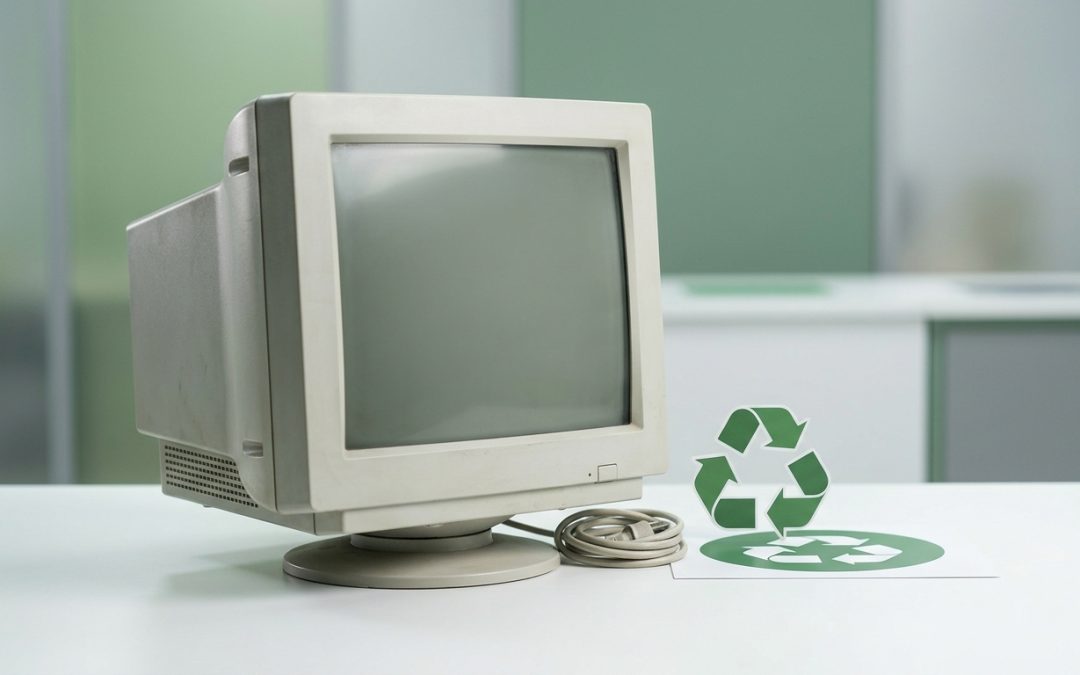
Monitors: One of the Trickiest E-Waste Items
Computer monitors are among the most commonly recycled electronic items, but they’re also among the most challenging to handle. Whether you’re dealing with an old CRT monitor from a storage cleanout or a flat-panel LCD that’s been replaced by something bigger, proper recycling ensures that hazardous materials are managed safely and valuable materials are recovered.
CRT Monitors: Handle with Extra Care
If you still have old CRT (cathode ray tube) monitors, the heavy, deep ones that dominated desktops through the early 2000s, they require the most careful handling of any common e-waste item:
Lead content. A typical CRT monitor contains 1-3 kg of lead in the funnel glass. This is the primary environmental concern because lead is a potent neurotoxin that leaches into groundwater when CRTs are landfilled.
Vacuum hazard. The CRT is a sealed glass tube under vacuum. If the tube is cracked or broken, it can implode, sending glass fragments in all directions. Never strike, drop, or attempt to break a CRT.
Residual electrical charge. Even unplugged, CRTs can retain high-voltage charge in their internal capacitors. This charge can deliver a dangerous shock if internal components are touched. Never open a CRT monitor casing.
Weight. CRT monitors are heavy, often 15-40 kg depending on screen size. Use proper lifting technique and get help for larger units to avoid injury.
LCD, LED, and OLED Monitors
Modern flat-panel monitors are lighter and contain fewer hazardous materials than CRTs, but they still need proper recycling:
Older LCD monitors (pre-2014 approximately) may contain mercury in their CCFL backlight tubes. When these monitors are broken or improperly dismantled, mercury can be released. Professional recyclers handle these screens in controlled conditions that prevent mercury exposure.
Newer LED-backlit monitors don’t contain mercury but still have circuit boards, power supplies, and plastics that should be recycled rather than landfilled.
OLED monitors contain organic compounds in their display layers and various metals in their electronics. While they don’t contain the same hazardous materials as CRTs or CCFL-backlit LCDs, they should still be processed through proper e-waste channels.
Where to Recycle Monitors
Council transfer stations. Most Victorian councils accept monitors at their transfer stations or resource recovery centres. CRT monitors are typically accepted alongside other e-waste, though some facilities have specific handling areas for them due to their weight and hazardous content.
Council hard waste collections. Monitors can usually be included in council hard waste pickups. Check your council’s specific guidelines because some have size or weight limits, and CRT monitors may have special placement requirements.
The National Television and Computer Recycling Scheme (NTCRS). Computer monitors are covered by this government-funded scheme, which provides free recycling through approved collection points. These points are funded by manufacturers and importers.
Commercial e-waste services. For businesses replacing multiple monitors, commercial collection services can handle volume pickups efficiently.
Can Your Old Monitor Be Reused?
Before recycling, assess whether the monitor still has useful life:
Working LCD monitors less than 8-10 years old often have plenty of life left. Monitor technology has matured, and a five-year-old 24-inch display is still perfectly adequate for office work, web browsing, and general use. If you’re replacing a working monitor for something bigger or with better colour accuracy, consider selling or donating the old one.
CRT monitors have no practical reuse value in almost all cases. They’re heavy, power-hungry, take up excessive desk space, and can’t match even basic flat-panel monitors for image quality. A few niche uses exist (retro gaming enthusiasts specifically seek certain CRT models), but for the vast majority, recycling is the right path.
Monitors with minor issues like a dead pixel or slight backlight bleed are still usable and may find buyers at reduced prices. Only monitors with serious problems like widespread dead pixels, cracked screens, or intermittent display failures should go directly to recycling.
Preparing a Monitor for Recycling
Disconnect all cables and include them with the monitor for recycling. Power cables and video cables (HDMI, DisplayPort, VGA, DVI) are all e-waste containing copper and should be recycled, not binned.
Remove the stand if detachable to make the monitor easier to transport and stack. The stand should be recycled along with the monitor.
Don’t wrap CRT monitors in plastic bags for transport. If the tube is cracked, trapped gases need to be able to dissipate. Use the original box if you still have it, or transport upright on a stable surface.
Monitors are one of the largest and most visible items in the e-waste stream, and getting them to proper recycling facilities is essential for managing the hazardous materials they contain. Whether yours is a vintage CRT or a modern flat panel, your nearest e-waste collection point is the right destination.
EWV helps Victorian businesses manage e-waste and IT asset disposal compliantly and sustainably — including collection, certified data destruction, and recycling. Contact us for a free quote.