
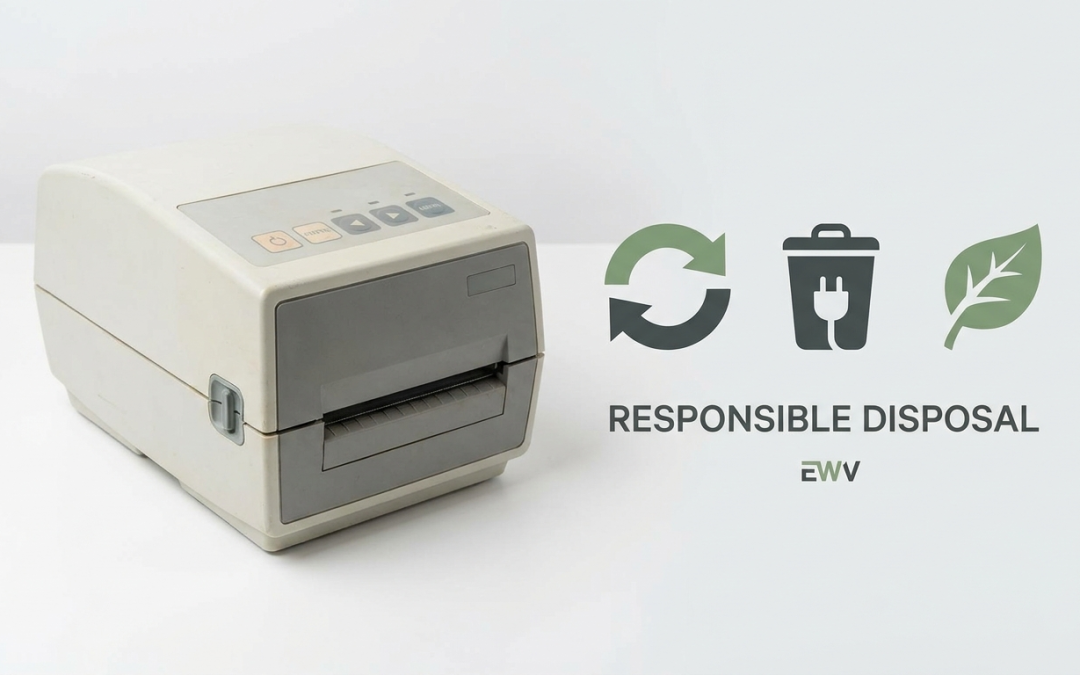
Label printers are found in warehouses, retail shops, offices, and shipping departments across Australia. From desktop Dymo units to industrial Zebra printers, these specialised devices eventually reach end of life and need proper disposal. While they are smaller and simpler than office printers, label printers still contain materials and sometimes data that deserve responsible handling.
Types of Label Printers
Desktop thermal label printers (Dymo, Brother P-Touch, Rollo) are compact units commonly used for shipping labels, file labels, and address labels. They use either direct thermal printing (heat-sensitive paper, no ink) or thermal transfer printing (ribbon-based). These are the simplest type and contain a thermal print head, a small circuit board, a stepper motor, plastic housing, and a power adapter.
Industrial label printers (Zebra, Honeywell, SATO) are built for high-volume environments like warehouses, manufacturing lines, and distribution centres. They are sturdier, contain more electronics, and may have network connectivity and internal storage that stores label templates, database connections, and network credentials.
Portable/handheld label makers (Brother, Dymo) are battery-powered units used for labelling around the office or workshop. They contain a small circuit board, thermal print head, and rechargeable or replaceable batteries.
Data Considerations
Most desktop label printers store minimal data. However, network-connected industrial label printers can store Wi-Fi or Ethernet network credentials, label template files (which may contain product information, pricing, or barcodes), database connection strings (if the printer pulls data from a database), FTP or cloud storage credentials, and firmware that may contain security certificates.
Before disposing of any network-connected label printer, perform a factory reset through the printer’s control panel or web interface. For Zebra printers, this is typically done by holding the feed button during power-on and following the configuration sequence. For other brands, check the manufacturer’s documentation.
Recycling Label Printers
Label printers contain the standard mix of e-waste materials: circuit boards, motors, plastic housings, metal components, and thermal print heads. The print heads contain a ceramic substrate with resistive heating elements that require proper recycling.
Council e-waste drop-off points accept label printers at transfer stations alongside other small electronics.
Professional e-waste recyclers accept label printers as part of their standard equipment streams.
Resale: Industrial label printers from brands like Zebra retain surprisingly good resale value. A well-maintained Zebra ZT410 or ZD620 that is only a few years old can fetch a meaningful fraction of its original price on the secondary market. Businesses upgrading their label printing infrastructure should consider resale through an ITAD provider before defaulting to recycling.
Consumables: Ribbons and Label Rolls
Do not forget the consumables that accumulate alongside label printers. Used thermal transfer ribbons contain a polyester film coated with wax, resin, or a wax-resin blend. These ribbons may retain a readable negative image of every label printed, essentially a carbon copy of all printed content. If your labels contained sensitive information (product codes, customer addresses, pricing), used ribbons should be treated as sensitive waste.
For sensitive environments, used ribbons should be shredded or sent through a secure destruction service. For non-sensitive applications, they can go in general waste as they do not contain hazardous materials, though recycling options for ribbon waste are limited.
Unused label rolls and ribbon stock can sometimes be donated to other businesses or organisations that use compatible printers.
Battery-Powered Label Makers
Handheld and portable label makers that run on rechargeable batteries should have the battery removed (if possible) and recycled through a battery recycling program. The label maker itself goes through standard e-waste channels.
Models with non-removable internal batteries should be recycled as complete units through e-waste channels, where the recycler will safely separate the battery during processing.
For more on e-waste recycling across all categories of office equipment, see our complete guide to e-waste recycling in Australia.
EWV helps Victorian businesses manage e-waste and IT asset disposal compliantly and sustainably — including collection, certified data destruction, and recycling. Contact us for a free quote.