
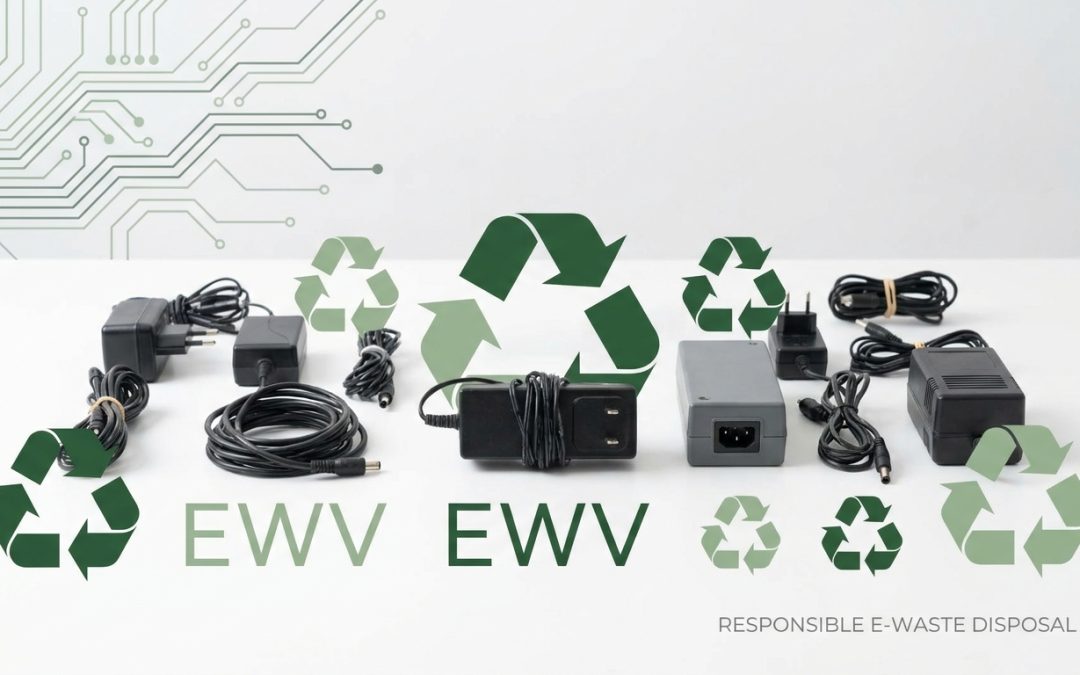
Power supplies and adapters are the unsung heroes of electronics, and they are also some of the most commonly accumulated and improperly discarded e-waste items. From the tangle of mismatched power bricks in the junk drawer to retired PC power supplies and laptop chargers, these devices contain valuable copper and other recyclable materials that should not end up in landfill.
Types of Power Supplies and Adapters
External power adapters (power bricks) are the small to medium boxes that convert mains power to the lower voltages needed by laptops, monitors, routers, and other devices. They contain a transformer (copper winding around a ferrite or iron core), capacitors, rectifier circuits, voltage regulation circuitry, and a plastic housing. Laptop chargers are the most common and most frequently replaced.
Wall plug adapters are compact power supplies that plug directly into the wall outlet. Phone chargers, tablet chargers, and small device adapters fall into this category. Modern USB-C and USB-A chargers contain surprisingly sophisticated power electronics including GaN (gallium nitride) or silicon switching circuits in newer models.
Desktop PC power supplies (PSUs) are the metal boxes inside desktop computers that convert mains power to the multiple voltages needed by computer components. They contain a fan, a transformer, large capacitors, a circuit board, and substantial copper wiring. They are among the most copper-rich components in a desktop computer.
Industrial and server power supplies are high-capacity units designed for continuous operation. They contain more copper, larger transformers, and more sophisticated circuitry than consumer units.
Why Power Supplies Are Worth Recycling
Power supplies contain a disproportionately high amount of copper relative to their size. The transformer alone in a typical laptop charger contains 50 to 150 grams of copper winding. A desktop PC power supply can contain 200 to 500 grams of copper between the transformer, output cables, and PCB traces.
Beyond copper, power supplies contain aluminium heat sinks, steel housings (in PC PSUs), ferrite cores in transformers, and circuit boards with the standard precious metal content. Some power supplies also contain electrolytic capacitors that should be properly recycled.
Safety Considerations
Power supplies contain components that can store dangerous electrical charge even after being unplugged. Large capacitors inside PC power supplies and industrial units can retain lethal voltages for hours or even days after disconnection.
Never open a power supply unless you are qualified to work with high-voltage electronics. The capacitors inside a PC power supply can store enough charge to cause serious injury or death. Simply recycle the unit intact through e-waste channels, and the recycler will handle disassembly safely.
This safety concern is one of the key reasons power supplies should go through professional e-waste recycling rather than being disassembled at home for materials recovery.
Recycling Options
Council e-waste drop-off points accept power supplies and adapters at transfer stations. Bag up your collection of old adapters and drop them off alongside other small electronics.
Professional e-waste recyclers accept power supplies as part of their standard streams. PC power supplies are particularly welcome due to their copper content.
Scrap metal dealers may accept large quantities of power supplies (particularly PC PSUs) due to the copper value. If you are disposing of a significant number, this can be a practical option.
Bundled with other e-waste: The most practical approach for most people is to collect power supplies and adapters in a box or bag and include them in your next e-waste disposal run, whether that is a trip to the council transfer station or a scheduled pickup by your e-waste recycler.
The Orphan Adapter Problem
One of the most frustrating aspects of power adapter waste is the orphan adapter problem. You dispose of a device but keep the charger “just in case.” Or a device breaks and the perfectly good charger goes into the drawer. Over time, you accumulate a collection of adapters where you are no longer sure which device each one belongs to.
The move toward USB-C as a universal charging standard is gradually reducing this problem. Modern laptops, tablets, phones, and many other devices can share the same USB-C charger, reducing the need for device-specific adapters. The EU’s universal charger mandate and similar Australian considerations are pushing the industry further in this direction.
In the meantime, a practical rule of thumb: if you have not used a power adapter in over two years, you probably never will. Recycle it.
Business Power Supply Disposal
Businesses accumulate power supplies at a much higher rate than households. Every desktop computer has a PSU. Every laptop has a charger. Monitors, printers, networking equipment, and peripherals all have power adapters. A typical office of 50 people might have 200 or more power supplies and adapters in active use, with dozens more sitting in storage from retired equipment.
When conducting an IT equipment refresh, include power supplies and adapters in the disposal scope. They are easy to overlook, but the cumulative copper content makes them one of the most valuable categories of small e-waste by weight.
For more on responsible disposal of all types of office electronics, see our complete guide to e-waste recycling in Australia.
EWV helps Victorian businesses manage e-waste and IT asset disposal compliantly and sustainably — including collection, certified data destruction, and recycling. Contact us for a free quote.