
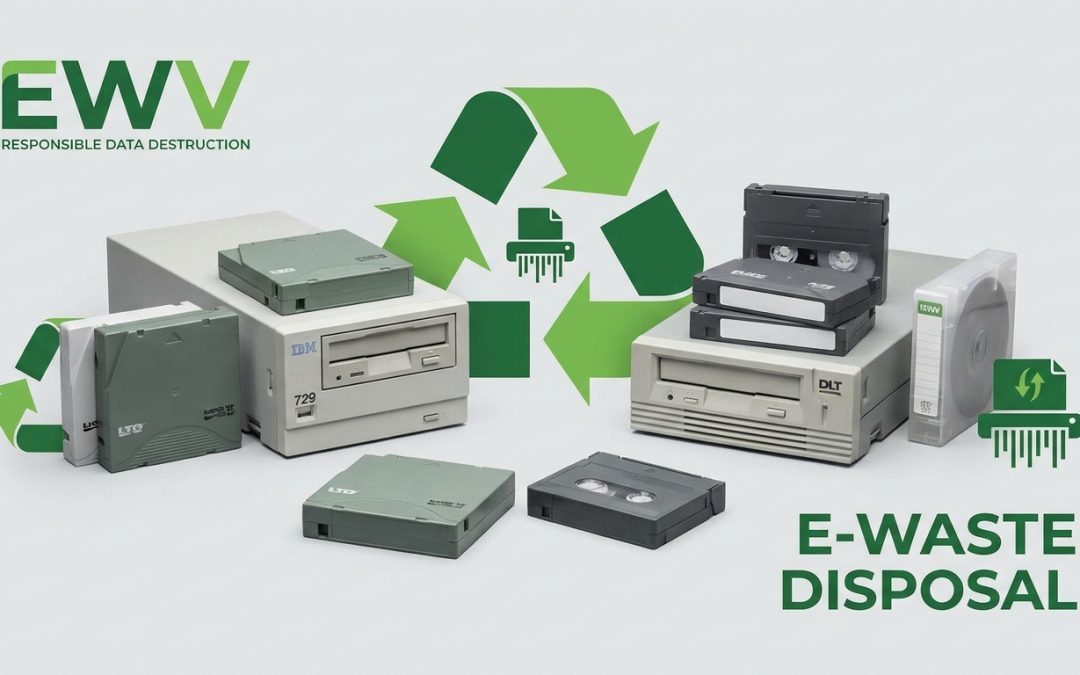
Magnetic tape remains a cornerstone of enterprise data backup and archival storage, but older tape drives and media are regularly retired as organisations upgrade to newer formats or shift to disk and cloud-based backup strategies. If your server room or storage closet contains old LTO drives, DDS/DAT tapes, or legacy formats like DLT or AIT, here is how to dispose of them responsibly.
Why Tape Media Is a Data Security Concern
Backup tapes are one of the most commonly overlooked data security risks during IT equipment disposal. A single LTO tape can hold up to 18 terabytes of compressed data (LTO-9), and even older formats hold substantial volumes. Organisations that have been running tape backups for years may have dozens or hundreds of tapes containing complete copies of their entire IT environment, including databases, email archives, file servers, and application data.
The data on these tapes does not become less sensitive with age. Old backup tapes may contain historical financial records, former employee information, legacy customer databases, outdated but still-valid credentials, intellectual property, and data subject to regulatory retention requirements.
Data Destruction Methods for Tape
Degaussing
Degaussing is the most common and effective method for destroying data on magnetic tape. A degausser generates a powerful magnetic field that randomises the magnetic particles on the tape, rendering all data irrecoverable. This is the recommended approach for most tape media and is specifically endorsed by NIST 800-88 Rev. 2 as a purge method for magnetic media.
The degausser must be rated for the coercivity of the tape format being processed. Modern LTO tapes have higher coercivity than older formats and require a more powerful degausser. Using an underpowered degausser may not fully destroy the data.
Physical Destruction
For maximum assurance, tapes can be physically destroyed by shredding. Industrial tape shredders cut the tape housing and media into small fragments. This is the most certain destruction method and is required by some security standards and government regulations.
Some organisations use a combination of degaussing followed by shredding for a belt-and-braces approach that satisfies the most stringent requirements.
Overwriting
Tapes can be overwritten using the tape drive, but this is the least practical option for disposal purposes. Overwriting a tape requires a compatible drive (which you may no longer have if you are retiring the format), takes a long time (hours per tape), and is less certain than degaussing because of potential issues with head alignment and edge tracks.
Tape Drive Disposal
The tape drive itself (the hardware that reads and writes tapes) is a precision electromechanical device containing a circuit board with controller electronics, read/write heads (containing small amounts of precious metals), motors and mechanical assemblies, a metal and plastic housing, and a power supply (for standalone units).
Tape drives should be recycled through professional e-waste or ITAD channels. Enterprise tape drives (particularly LTO drives) can have meaningful resale value if they are functional and from a recent generation. LTO-8 and LTO-9 drives, for example, are expensive new and command reasonable second-hand prices.
Autoloaders and tape libraries (which house multiple drives and automated tape handling mechanisms) are larger and more complex. These contain motors, robotics, multiple drives, and substantial metal construction. Professional collection is typically required due to size and weight.
Types of Tape Media You Might Encounter
LTO (Linear Tape-Open): The current standard for enterprise tape backup. Generations range from LTO-1 (100GB native) through LTO-9 (18TB native). Older generations are being retired as organisations upgrade.
DDS/DAT (Digital Data Storage/Digital Audio Tape): An older small-format tape used in small business and departmental backup. Capacities ranged from 2GB to 80GB. These are almost entirely obsolete.
DLT/SDLT (Digital Linear Tape): A mid-range enterprise format that was popular in the late 1990s and 2000s. Replaced by LTO in most environments.
AIT (Advanced Intelligent Tape): Sony’s enterprise tape format, discontinued in 2010. Still found in some legacy environments.
Travan and QIC: Very old formats from the 1990s. If you find these, they have been in storage for a very long time.
The Challenge of Legacy Tape Formats
One of the unique challenges with tape disposal is that older tapes may contain data that can no longer be read because compatible drives are no longer available. An organisation might have DLT tapes from 2005 with no DLT drive to read them. The data on these tapes might be important (potentially required for legal or regulatory retention) or it might be completely irrelevant.
Before destroying legacy tapes, consider whether the data might be needed for regulatory compliance (some industries require data retention for 7-10 years or longer), legal discovery (litigation hold requirements may apply), historical or archival purposes, or migration to a current format for continued retention.
If there is any chance the data is needed, arrange to have the tapes read using a compatible drive (data recovery services can sometimes source legacy drives) and migrate the data to current media or cloud storage before destroying the tapes.
Recycling the Tape Media
After data destruction, the physical tape cartridges contain recyclable materials. The tape itself is a polyester (PET) film coated with magnetic particles (typically metal particle or barium ferrite). The cartridge housing is ABS plastic. Internal mechanisms include springs, guides, and sometimes a small memory chip (in LTO cartridges, the CM chip stores usage data).
Professional e-waste recyclers and ITAD providers that handle tape destruction typically also handle the materials recycling, processing the destroyed tape and cartridge materials through appropriate streams.
For comprehensive guidance on data destruction across all media types, see our guide to NIST 800-88.
EWV helps Victorian businesses manage e-waste and IT asset disposal compliantly and sustainably — including collection, certified data destruction, and recycling. Contact us for a free quote.