
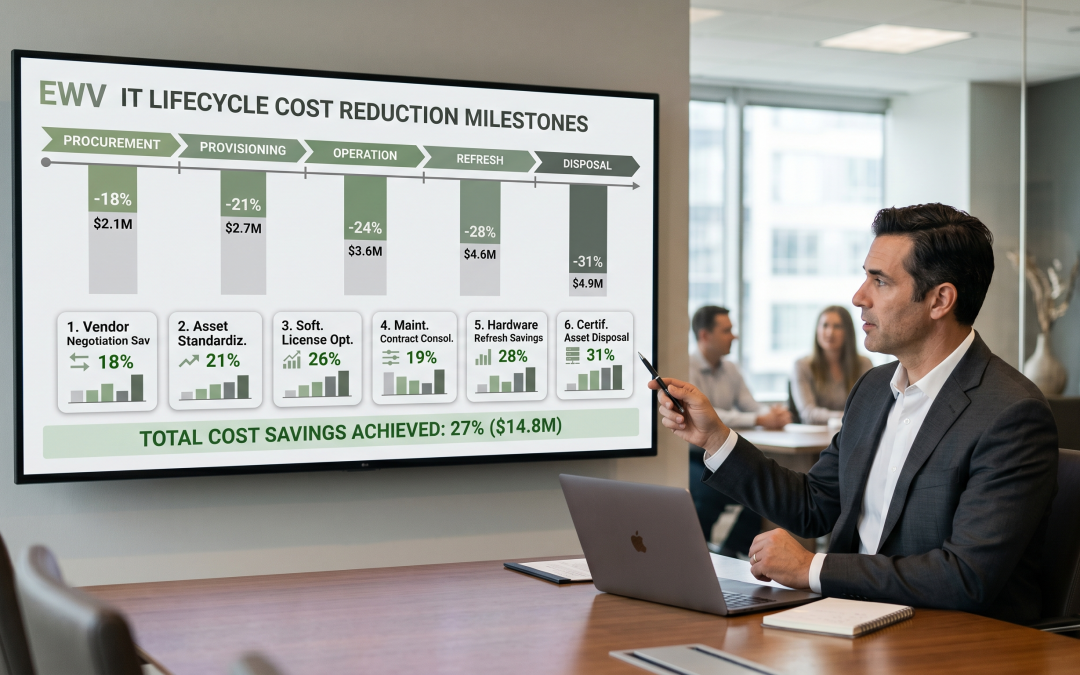
IT costs do not end when you stop using a piece of equipment. They continue through storage, disposal, and the opportunity cost of not recovering value from retired assets. Conversely, costs can be reduced at every stage of the lifecycle if you manage procurement, use, and disposal as a connected whole rather than separate activities. Better lifecycle management reduces total IT costs while improving security and environmental outcomes.
The Lifecycle Cost Perspective
Most organisations manage IT costs in silos. Procurement handles purchase prices and vendor negotiations. IT operations manages maintenance and support costs. Facilities deals with space and power. And disposal, if it has a budget at all, is treated as a minor cleanup activity. This siloed approach misses the connections between lifecycle stages that drive total cost.
A lifecycle perspective recognises that decisions at one stage affect costs at others. Buying cheaper equipment may reduce procurement costs but increase maintenance costs and reduce resale value at disposal. Extending equipment life beyond its useful period reduces procurement costs but increases support costs and eliminates remarketing revenue. Stockpiling retired equipment avoids disposal costs temporarily but accumulates storage costs, value depreciation, and security risk.
Procurement Decisions That Reduce Lifecycle Costs
Better lifecycle management starts at procurement. Standardising on fewer equipment models simplifies management throughout the lifecycle and improves disposal efficiency. Standard models are easier to support, spare parts are more readily available, and consistent batches of the same model achieve better remarketing prices than mixed lots.
Choosing equipment with good resale characteristics can improve your total cost of ownership. Business-grade equipment from major brands holds value better than consumer-grade alternatives. Devices with user-replaceable components (batteries, RAM, storage) maintain their value longer because they can be upgraded and refurbished more easily.
Negotiating with vendors on end-of-life terms, such as trade-in programs, buy-back guarantees, or disposal support, can improve the economics at the disposal stage.
Optimising the Useful Life
The optimal useful life for IT equipment balances several competing factors. Running equipment for longer reduces procurement costs but increases maintenance costs, reduces productivity (as older equipment becomes slower), and diminishes resale value at disposal.
For most business laptops, the sweet spot is between three and four years. At three years, the equipment is still functional and has meaningful resale value. By five years, maintenance costs have risen, productivity has declined, and resale value is minimal.
The optimal lifecycle varies by equipment type. Servers may have longer optimal lifecycles if they remain adequate for their workload. Mobile devices may have shorter optimal lifecycles due to rapid technology advancement and battery degradation.
Internal redeployment extends useful life without extending ownership. A device retired from a power user might serve another two years for a less demanding role before entering the disposal stream.
Reducing Disposal Costs
Several strategies reduce the cost of the disposal stage specifically. Disposing promptly rather than stockpiling maximises value recovery and eliminates storage costs. Consolidating disposals into larger, less frequent batches achieves better per-unit processing rates. Maintaining equipment well during its active life preserves condition and resale value. Including all original accessories improves remarketing returns.
Working with a capable ITAD provider with strong remarketing channels maximises value recovery, which is the single biggest lever for reducing net disposal costs. Some organisations achieve net-positive disposal economics where remarketing revenue exceeds processing costs.
Data-Driven Lifecycle Decisions
Better lifecycle management requires data. Track the total cost at each lifecycle stage for different equipment types. Monitor maintenance costs by device age to identify the point where support costs accelerate. Record disposal outcomes including processing costs and value recovery to understand true end-of-life economics. And analyse trends over time to refine lifecycle strategies.
This data transforms lifecycle management from guesswork into evidence-based decision-making. Each disposal cycle generates insights that improve the next procurement cycle, creating a continuous improvement loop across the entire asset lifecycle.
Organisational Alignment
Effective lifecycle management requires collaboration between procurement, IT operations, finance, security, and facilities. When these teams share data and align on lifecycle strategies, the total cost reductions are significant. When they operate in silos, cost-shifting between departments masks the true lifecycle cost and prevents optimisation.
Consider establishing a cross-functional team or regular forum to discuss IT lifecycle strategy, review performance data, and make coordinated decisions about procurement standards, refresh timing, and disposal approaches.
EWV helps Victorian businesses manage e-waste and IT asset disposal compliantly and sustainably — including collection, certified data destruction, and recycling. Contact us for a free quote.