
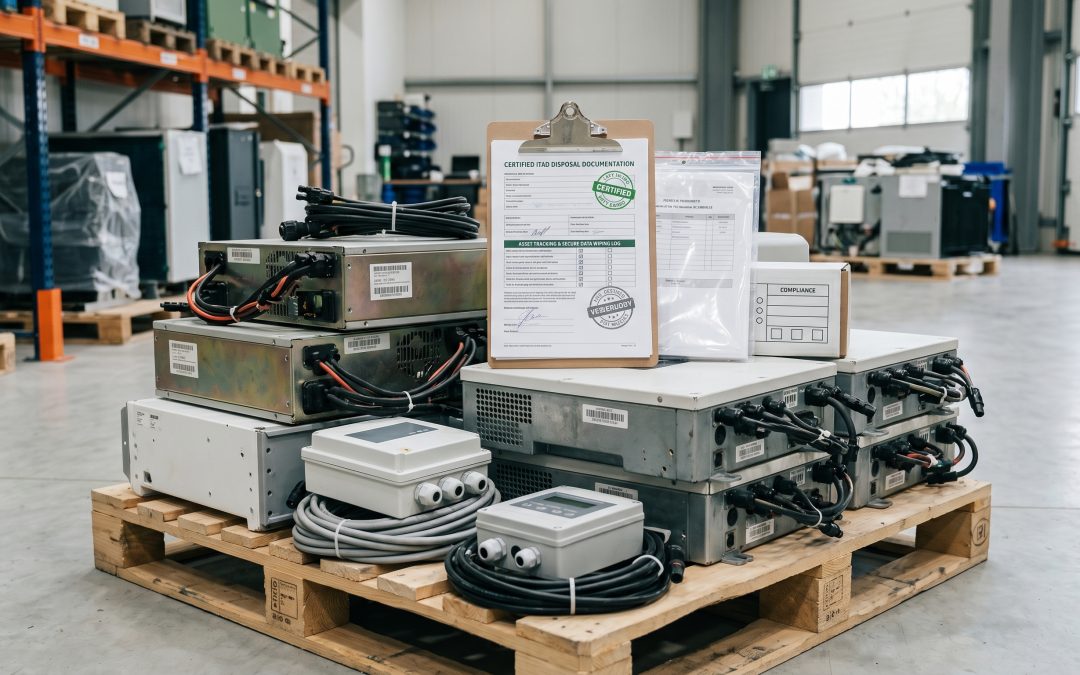
Australia’s renewable energy sector is growing rapidly, with solar farms, wind installations, and battery storage systems proliferating across the country. Behind every renewable energy installation sits monitoring and control equipment that tracks performance, manages grid connections, and optimises energy production. When this equipment reaches end of life or installations are upgraded, disposing of the monitoring infrastructure raises both data security and environmental questions.
What Monitoring Equipment Contains
Renewable energy monitoring systems encompass a wide range of IT equipment. Solar installations typically include string-level monitoring devices attached to each panel group, inverter controllers with embedded processors and storage, site-level data loggers and communication gateways, weather stations with data recording capabilities, and SCADA or supervisory systems for larger installations.
Wind farms add complexity with turbine-specific controllers, vibration monitoring systems, pitch and yaw control computers, and condition monitoring equipment. Battery energy storage systems include battery management systems (BMS), power conversion controllers, and thermal management computers.
All of these components store data, connect to networks, and accumulate operational information over their service life.
Types of Data at Risk
The data stored on renewable energy monitoring equipment may not seem immediately sensitive, but it can have real commercial and security implications. Performance data reveals the actual output, efficiency, and degradation rates of the installation. For commercially operated renewable assets, this data directly impacts asset valuation and can influence energy trading strategies.
Grid connection parameters, including protection relay settings, power quality data, and grid compliance configurations, represent technical information about how the installation interfaces with the electricity network. In the wrong hands, this data could inform attempts to disrupt grid stability.
Network credentials are a significant concern. Monitoring equipment typically connects to remote management platforms via cellular, satellite, or internet connections. These credentials, if not properly removed before disposal, could provide access to the operator’s wider network of renewable assets.
Contractual and commercial data may also be present. Some monitoring systems store power purchase agreement parameters, feed-in tariff configurations, or renewable energy certificate generation data that has commercial sensitivity.
The Scale of the Coming Challenge
Australia’s first wave of large-scale solar installations is now approaching the age where monitoring equipment upgrades or replacements become necessary. While solar panels themselves may last 25 to 30 years, the electronic monitoring and control equipment typically has a shorter lifespan of 10 to 15 years. This means a significant volume of monitoring equipment from installations built during the solar boom of the mid-2010s will need to be decommissioned in the coming years.
Wind farms face similar timelines, with early monitoring systems being replaced by more advanced analytics platforms. The transition to smart inverters and more sophisticated grid management is also driving upgrades that generate decommissioned equipment.
Secure Disposal Practices
Before removing monitoring equipment from a renewable energy site, take these steps to protect operational data. Disconnect the equipment from all network connections and revoke its access to remote monitoring platforms. Change any shared credentials that the device had access to, as other equipment at the site may use the same network infrastructure.
For equipment with accessible storage media (hard drives, SSDs, SD cards, USB storage), apply standard data sanitisation procedures. Many data loggers and communication gateways use removable SD cards that can be easily identified and wiped or destroyed.
Embedded systems with soldered flash storage present more of a challenge. For these devices, check whether the manufacturer provides a factory reset function that performs a genuine data erasure rather than simply restoring default settings. Where this is not available or not verifiable, physical destruction of the storage components is the most reliable approach.
For large installations with dozens or hundreds of monitoring devices, develop a systematic decommissioning plan that tracks each device from removal through to confirmed data destruction. Maintaining this documentation demonstrates due diligence and supports compliance requirements.
Environmental Responsibilities
Monitoring equipment from renewable energy installations contains electronic components that must be disposed of responsibly. Under Victoria’s e-waste regulations, electronic equipment cannot be sent to landfill. This applies to all the monitoring hardware, from small string-level devices to site controllers and communication equipment.
There is a certain irony in renewable energy equipment contributing to the e-waste stream, but responsible management of this waste is part of the broader commitment to sustainability that drives the renewable sector. Proper recycling recovers valuable materials including copper, aluminium, precious metals from circuit boards, and various plastics, keeping these resources in the circular economy.
Outdoor monitoring equipment may also have weatherproofing materials, potting compounds, and sealants that need appropriate handling during recycling. Communication antennas, cables, and mounting hardware can generally be recycled as metal waste.
Integrating Disposal into Asset Management
Renewable energy operators should include monitoring equipment in their overall IT asset lifecycle management framework. This means maintaining an inventory of all data-bearing devices across each installation, classifying the sensitivity of data stored on different equipment types, establishing data retention and destruction policies specific to operational technology, and building disposal requirements into procurement contracts for new monitoring equipment. As the renewable energy sector matures, treating the end-of-life management of monitoring infrastructure with the same professionalism as its deployment reflects well on the industry and aligns with its core sustainability values.
EWV provides e-waste collection and recycling for Victorian businesses, responsibly processing electronic equipment through certified downstream partners. Book a collection to keep your e-waste out of landfill.