
Why Research Data Requires Specialised Destruction Practices
Research institutions generate and store data that is often irreplaceable, commercially valuable, and subject to strict regulatory oversight. Universities, CSIRO facilities, medical research institutes, and private R&D labs accumulate vast quantities of research data across servers, workstations, laboratory instruments, and portable storage. When this equipment reaches end of life, the data it contains demands careful handling that goes beyond standard corporate IT disposal.
Research data can include everything from raw experimental results and proprietary methodologies to participant records from human research studies and intellectual property that may be worth millions in future commercialisation. The stakes of improper disposal are high, potentially compromising years of work, violating ethics approvals, or exposing sensitive participant information.
Categories of Research Data at Risk
Human research data represents the most sensitive category in most research institutions. Clinical trials, psychological studies, social research, and epidemiological projects collect detailed personal information from participants who have consented to specific uses of their data. Ethics approvals typically include strict requirements about data storage, access, and destruction that persist long after the research project concludes.
Proprietary research and intellectual property form another critical category. Pre-patent research findings, novel methodologies, unpublished results, and commercial research conducted under contract all have significant economic value. Competitors, whether academic or commercial, could benefit enormously from access to this data.
Government-funded research often comes with specific data management requirements attached to the grant conditions. The Australian Research Council (ARC) and National Health and Medical Research Council (NHMRC) both have data management expectations that include provisions for secure destruction at the end of retention periods.
Collaborative research data presents unique challenges because multiple institutions may hold copies, and data sharing agreements may specify different retention and destruction requirements for each party. Ensuring coordinated destruction across all collaborating institutions requires clear communication and documented processes.
Regulatory and Ethical Requirements
The Australian Privacy Act applies to research institutions that collect personal information, with specific provisions for health information under state and territory health records legislation. The National Statement on Ethical Conduct in Human Research provides additional guidance on data management and destruction for research involving human participants.
Most institutional ethics committees require researchers to specify data retention periods and destruction methods as part of their ethics applications. These commitments are binding, and failure to follow through on destruction timelines can constitute a breach of ethics approval. This creates a direct link between IT asset disposal and research ethics compliance.
For research involving defence or dual-use technologies, the Defence Trade Controls Act 2012 imposes additional obligations around data handling and destruction. Research institutions working in areas like advanced materials, cybersecurity, or certain biological sciences need to ensure their disposal processes meet these heightened requirements.
Equipment Types in Research Environments
Research institutions use a wider variety of data-bearing equipment than most organisations. Standard IT assets like servers, desktops, and laptops are just the starting point. Laboratory instruments increasingly contain embedded computers and internal storage that accumulate research data over years of use. Mass spectrometers, gene sequencers, electron microscopes, and other analytical instruments may store raw data, calibration files, and method parameters internally.
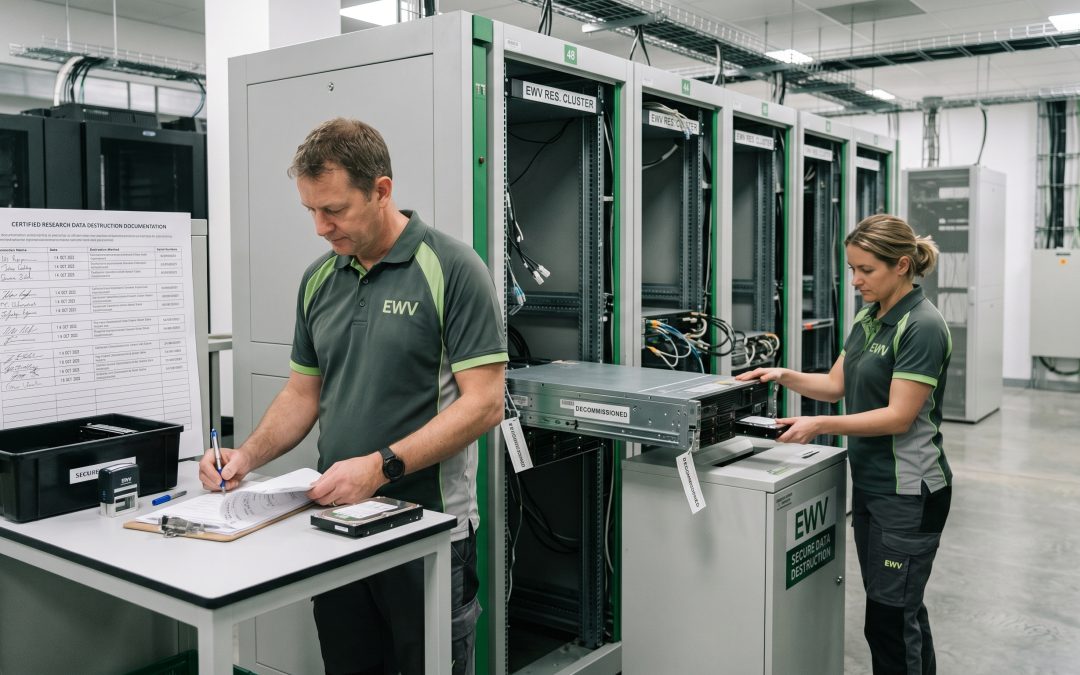
High-performance computing clusters and research storage arrays can contain petabytes of data spread across hundreds of drives. Decommissioning these systems requires a systematic approach to ensure every drive in the array is accounted for and properly sanitised.
Field research equipment, including data loggers, GPS trackers, environmental sensors, and portable recording devices, often contains data collected in remote locations. These devices may be stored in departmental cupboards for extended periods before anyone considers the data they contain.
Best Practices for Research Data Destruction
The foundation of effective research data destruction is a comprehensive data mapping exercise. Institutions need to know what data exists, where it is stored, which projects it relates to, and what retention and destruction requirements apply. This mapping should be maintained throughout the research lifecycle, not constructed after the fact when equipment is being decommissioned.
For standard IT equipment, software-based sanitisation following NIST 800-88 guidelines is appropriate for most research data. For highly sensitive material, such as defence-related research, commercially critical IP, or data covered by special ethics conditions, physical destruction provides the highest assurance.
Laboratory instruments with embedded storage require coordination between IT departments and research teams. Researchers should be involved in identifying what data an instrument may contain, while IT teams handle the technical aspects of data removal. Manufacturer guidance may be needed for instruments with proprietary storage systems.
Engaging a certified IT asset disposition provider with experience in research environments can help institutions manage the complexity of multi-department, multi-project disposal requirements. Look for providers who can accommodate the documentation needs specific to research, including linking destruction certificates to individual research projects and ethics approvals.
Institutional Policy Recommendations
Research institutions should develop data destruction policies that bridge the gap between IT asset management and research data governance. These policies should clearly assign responsibilities, recognising that research data destruction is a shared obligation between IT services, individual researchers, and departmental leadership.
Training is essential. Researchers often focus intensely on data collection and analysis but give little thought to end-of-life data management. Including data destruction planning in research methods training and ethics application processes helps embed good practices from the start of each project.
Regular audits of IT assets against research project records can identify equipment that should have been decommissioned and data that should have been destroyed. These audits also help identify orphaned data, information on devices associated with researchers who have left the institution or projects that have concluded without formal data closure.
Preserving Research Integrity Through Proper Disposal
For research institutions, data destruction is ultimately about maintaining the integrity and trustworthiness of the research enterprise. Participants trust that their data will be handled as promised. Funders expect that grant conditions will be met. Collaborators rely on agreed data management practices being followed. By establishing clear, consistent data destruction processes that are integrated with broader information security practices, research institutions protect both their current work and their ability to conduct trusted research in the future.
EWV provides NIST 800-88 certified data destruction for Victorian businesses, covering software-based erasure and physical destruction with full chain-of-custody documentation. Request a quote to discuss your requirements.