
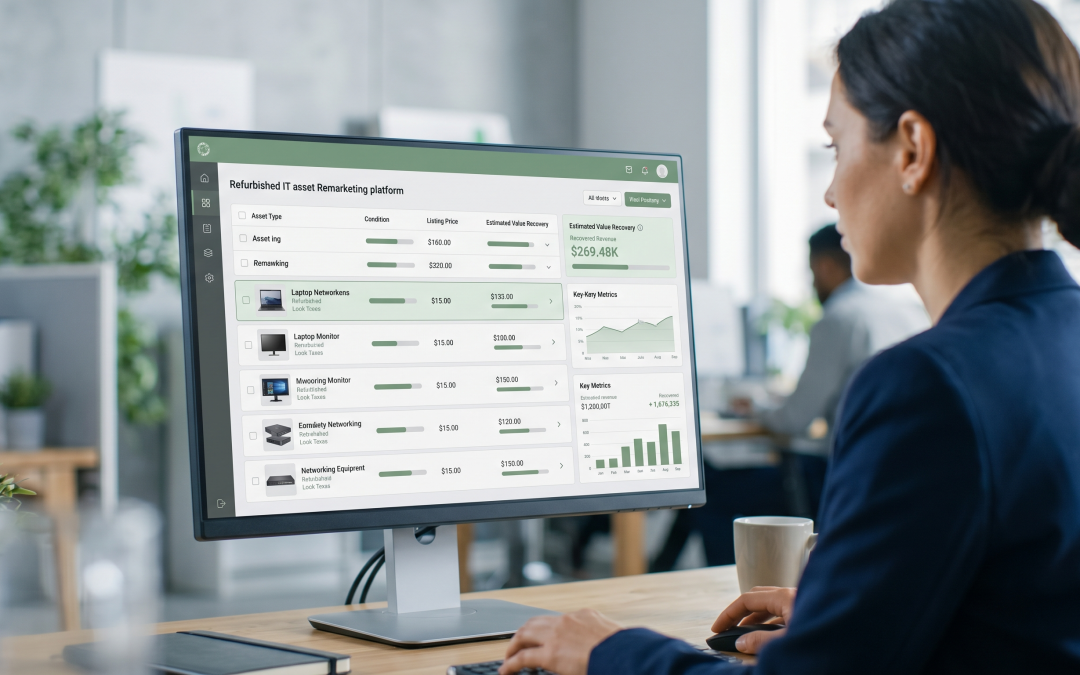
IT asset remarketing transforms equipment disposal from a pure cost into a revenue opportunity. For organisations with regular technology refresh cycles, the revenue recovered through remarketing can be substantial, offsetting disposal costs and contributing meaningfully to IT budgets. Understanding how to maximise remarketing revenue requires attention to timing, provider selection, and process optimisation.
How Revenue Recovery Works
Revenue recovery through remarketing follows a predictable process. Retired equipment is collected and transported to the processing facility. Data is securely sanitised using certified methods that preserve device functionality. Each device undergoes functional testing and receives a condition grade. Devices are then listed and sold through appropriate secondary market channels. Revenue is returned to the client, either as a buy-back payment, a revenue share, or a combination.
The revenue you receive is the gross sale price minus the provider’s processing costs and margin. Different providers offer different commercial models, and the net return can vary significantly depending on the provider’s remarketing capability and the commercial arrangement you negotiate.
Factors That Maximise Revenue
Several factors within your control significantly affect remarketing revenue. Timing is the single most impactful factor. IT equipment depreciates rapidly, with values declining 20-30% per year for most categories. A laptop that could generate $400 in remarketing revenue at two years old might return only $200 at three years and $75 at four years. Disposing of equipment promptly when it is retired from active use, rather than stockpiling it, captures the highest possible value.
Equipment condition directly affects the resale price. Devices in Grade A condition (near-new) sell for significantly more than Grade C devices (functional but visibly worn). Maintaining equipment well during its active life, including using protective cases, providing proper storage when not in use, and addressing minor issues promptly, preserves cosmetic condition and battery health that translate directly into higher resale prices.
Including original accessories adds value. A laptop with its original charger, docking station, and carrying case commands a higher price than the same laptop sold alone. Collect and include accessories whenever possible.
Volume creates opportunities. Larger batches of consistent equipment attract more buyer interest and often achieve better per-unit prices than one-off sales. If possible, consolidate disposals into larger batches rather than processing small quantities frequently.
Choosing the Right Provider
Not all ITAD providers have equal remarketing capabilities. A provider with strong remarketing generates better returns for you. Evaluate their testing and grading processes (more thorough testing leads to more accurate grading and better pricing). Assess their sales channels, including direct B2B sales, auction platforms, wholesale, and export markets. Providers with multiple channels can optimise returns by directing each device to the channel where it will achieve the best price.
Ask about their market reach. Providers who sell only domestically may miss opportunities in international markets where demand for specific equipment types is stronger. Conversely, providers focused solely on export may not achieve the best prices for equipment with strong domestic demand.
Review their track record by asking for historical return data on equipment similar to yours. A provider who consistently achieves market-rate or above-market returns is worth more than one who offers lower processing fees but generates weak resale results.
Commercial Models
The commercial model you agree with your provider affects both the certainty and the quantum of your returns. A buy-back model provides certainty: the provider pays you a fixed amount per device upfront. You know exactly what you will receive, but the price reflects the provider taking on the risk that equipment may sell for less than expected.
A revenue share model provides potential upside: the provider sells the equipment and splits the proceeds with you. If the equipment sells well, you receive more than you would under a buy-back arrangement. But if market conditions are weak or equipment is in worse condition than expected, returns may be lower.
A guaranteed minimum with upside sharing combines elements of both. You receive a guaranteed minimum payment per device, plus a share of any revenue above that minimum. This protects your downside while preserving some upside potential.
Tracking and Reporting
Insist on transparent reporting from your provider regarding remarketing outcomes. You should receive details of each device remarketed, including its serial number, grade, and sale price. This transparency allows you to verify that returns are fair, track performance trends over time, and identify opportunities for improvement.
Compare your provider’s reported sale prices against publicly available secondary market pricing (eBay sold listings, refurbished equipment retailers, wholesale pricing databases) to validate that their returns are reasonable.
Integrating Revenue Recovery into Financial Planning
Once you have a track record of remarketing returns, integrate this data into your broader financial planning. Use historical returns to forecast future recovery revenue in your ITAD budget. Factor expected remarketing income into total cost of ownership calculations for new equipment purchases. Report revenue recovery alongside disposal costs to demonstrate the net financial performance of your ITAD program to leadership.
Over time, a well-managed remarketing program becomes a predictable financial input that contributes positively to your IT operations budget.
EWV handles IT asset disposition (ITAD) end-to-end for Victorian businesses — from collection and data destruction through to certified recycling or refurbishment for resale. Get in touch for a tailored ITAD quote.