
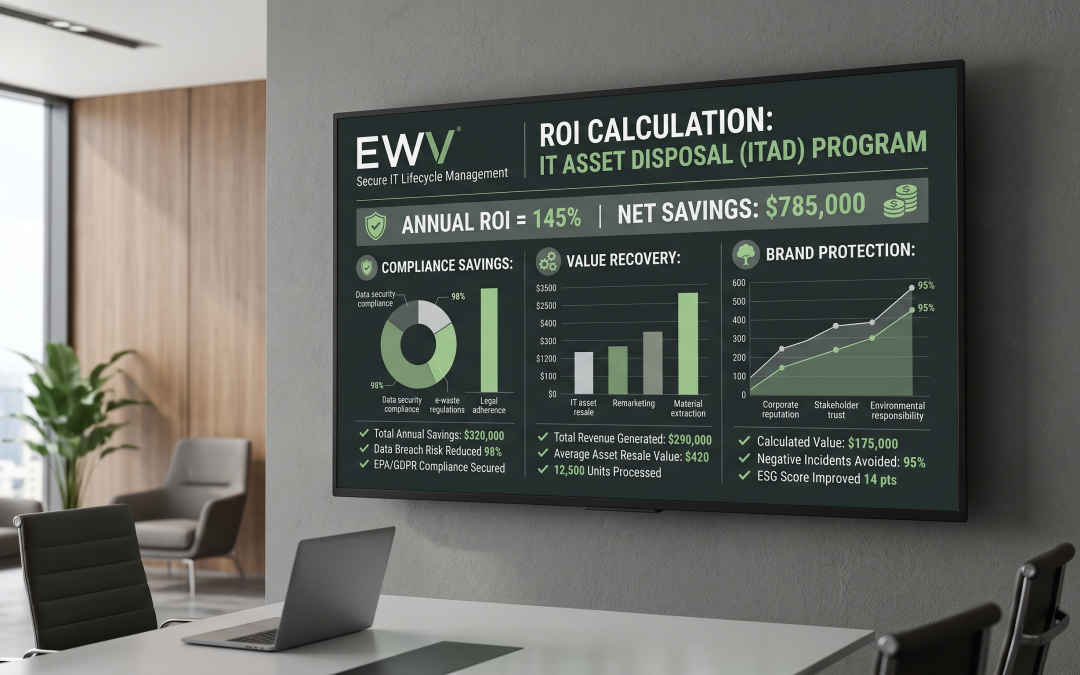
Convincing leadership to invest in a structured ITAD program often requires demonstrating a clear return on investment. The good news is that proper IT asset disposal delivers measurable returns across multiple dimensions: direct financial returns from value recovery, cost avoidance from prevented data breaches, operational savings from recovered space and reduced management overhead, and reputational value from demonstrated environmental responsibility.
Direct Financial Returns
The most tangible ROI comes from value recovery through remarketing. Equipment that is professionally processed, tested, and sold on secondary markets generates revenue that directly offsets disposal costs. For organisations with regular refresh cycles involving relatively recent equipment, value recovery often exceeds processing costs, making the ITAD program net revenue-positive.
Consider a mid-sized organisation disposing of 500 laptops at the end of a three-year refresh cycle. At an average recovery of $300 per device, that is $150,000 in value recovery. Subtract processing costs of perhaps $15-25 per device ($7,500-12,500 total) and you have a net return of roughly $137,500-142,500. Compare that to the alternative of stockpiling equipment in storage rooms with zero return and ongoing costs.
Value recovery is not limited to laptops. Servers, networking equipment, mobile devices, and even some peripherals can generate meaningful returns when processed through professional ITAD channels.
Cost Avoidance: Data Breach Prevention
The cost avoidance from preventing data breaches through proper disposal is potentially the largest component of ITAD ROI, though it is harder to quantify because it represents an event that did not happen. The average cost of a data breach in Australia exceeds $4 million according to industry studies, and breaches from improperly disposed equipment are entirely preventable.
Even a modest-probability scenario makes the case compelling. If there is a 2% annual chance of a data breach from improper disposal, the expected cost is $80,000 per year (2% times $4 million). An ITAD program that costs $50,000 per year and eliminates this risk has a clear positive ROI from risk reduction alone, before counting any other benefits.
Beyond the direct financial cost, data breach prevention also avoids regulatory investigation costs, customer notification expenses, potential class action exposure, and the significant but hard-to-quantify cost of reputational damage.
Operational Savings
Proper ITAD generates operational savings that are real even if they do not appear on a separate line item. Space recovery is the most immediate. Office space occupied by stockpiled equipment has a real cost, particularly in urban locations where commercial rent is substantial. Clearing out old equipment and converting that space to productive use, or reducing your overall footprint, delivers ongoing savings.
Reduced management overhead follows from having a structured program. Ad hoc disposal is inefficient, requiring staff to reinvent the process each time, negotiate with providers, and manage logistics without established procedures. A standing ITAD program with an established provider and documented processes is significantly more efficient.
Improved asset management is a secondary benefit. The discipline of tracking assets through disposal improves overall IT asset management, leading to better procurement planning, more accurate budgets, and fewer lost or unaccounted devices.
Compliance Value
Meeting your obligations under the Privacy Act, environmental regulations, and industry-specific requirements has financial value. Non-compliance can result in penalties, enforcement actions, and mandatory remediation costs that far exceed the cost of a proper ITAD program.
Under Victoria’s e-waste landfill ban, improper disposal of electronic equipment can attract penalties. Under the Privacy Act, failure to take reasonable steps to destroy personal information can result in regulatory action. In regulated industries like financial services and healthcare, non-compliant disposal practices can trigger investigations and sanctions.
A structured ITAD program with documented processes and certified providers provides evidence of compliance that protects against these risks.
Sustainability and Reputational Value
While harder to quantify in dollar terms, the reputational value of responsible IT disposal is increasingly significant. Customers, investors, and employees all consider sustainability performance when making decisions. A well-managed ITAD program provides concrete environmental metrics (CO2e avoided, materials recycled, landfill diverted) that strengthen your organisation’s ESG disclosures and sustainability communications.
For organisations competing for contracts where sustainability is evaluated (government tenders, corporate procurement with ESG criteria), demonstrated responsible disposal practices can be a genuine competitive differentiator.
Building the Business Case
When presenting the ITAD ROI to leadership, combine quantitative and qualitative elements. Lead with the numbers: value recovery projections based on your actual equipment inventory, processing cost estimates from provider quotes, and risk-adjusted cost avoidance from breach prevention. Then support with the qualitative benefits: compliance assurance, sustainability outcomes, and operational improvements.
Present the comparison explicitly. Show the cost of a structured ITAD program alongside the cost of the alternative: stockpiling equipment, ad hoc disposal, unmanaged risk, and foregone value recovery. When framed as a choice between two options rather than an additional expense, the structured program almost always wins.
Measuring and Reporting ROI
After implementing your ITAD program, track actual performance against your ROI projections. Report value recovery achieved, processing costs incurred, any incidents avoided, and environmental outcomes delivered. This ongoing measurement demonstrates the program’s value and justifies continued investment, while also identifying opportunities for improvement.
EWV handles IT asset disposition (ITAD) end-to-end for Victorian businesses — from collection and data destruction through to certified recycling or refurbishment for resale. Get in touch for a tailored ITAD quote.