
Last updated: November 2026. Facts checked against DCCEEW, NSW EPA, Solar Victoria and Parliament of Australia sources on 19 November 2026.
Solar panel recycling in Australia is still voluntary in most of the country, and only a small share of old panels is recycled. Victoria bans e-waste, including solar panels, from landfill. NSW has finished consulting on Australia’s first mandatory solar panel stewardship scheme, which is expected to start in early 2028. A $24.7 million federal recycling pilot announced in January 2026 was put on hold in May after a procurement complaint, and on 10 November 2026 the government cancelled the procurement without appointing anyone to run it.
About one in three Australian households has rooftop solar, and the first large wave of those panels is reaching the end of its life. This article explains what happens to old panels now, what each level of government is doing, and what to do with panels you are replacing.
Key takeaways
- The federal government expects around one million tonnes of solar panel waste, about fifty million panels, by 2035.
- The government says only 17 per cent of solar panels are currently recycled.
- In Victoria, solar panels are e-waste and must not go to landfill. They must go to a lawful e-waste collection point or a solar PV recycler.
- NSW’s draft solar panel stewardship regulation closed for comment at 5pm on 16 November 2026. The scheme is expected to start in early 2028.
- The procurement for the National Solar Panel Recycling Pilot ($24.7 million over three years) was suspended in May 2026 and cancelled on 10 November 2026 without a contract being awarded. The government says it is considering next steps.
- A federal parliamentary inquiry into solar panel reuse and recycling has not yet reported.
How much solar panel waste does Australia produce?
The Department of Climate Change, Energy, the Environment and Water (DCCEEW) expects Australia to generate around one million tonnes of solar panel waste, about fifty million panels, by 2035. NSW’s environment department has published estimates that annual panel waste will grow from 59,340 tonnes in 2025 to 91,165 tonnes in 2030.
Most panels are designed to last 20 to 30 years, but many are removed earlier: when a household upgrades to a larger system, when a roof is replaced, after storm or hail damage, or when a solar farm is repowered with newer panels.
When the federal pilot was announced on 16 January 2026, the government said only 17 per cent of solar panels were being recycled. DCCEEW lists high logistics costs, high recycling costs and limited processing capacity as the main barriers.
What is a solar panel made of, and can it be recycled?
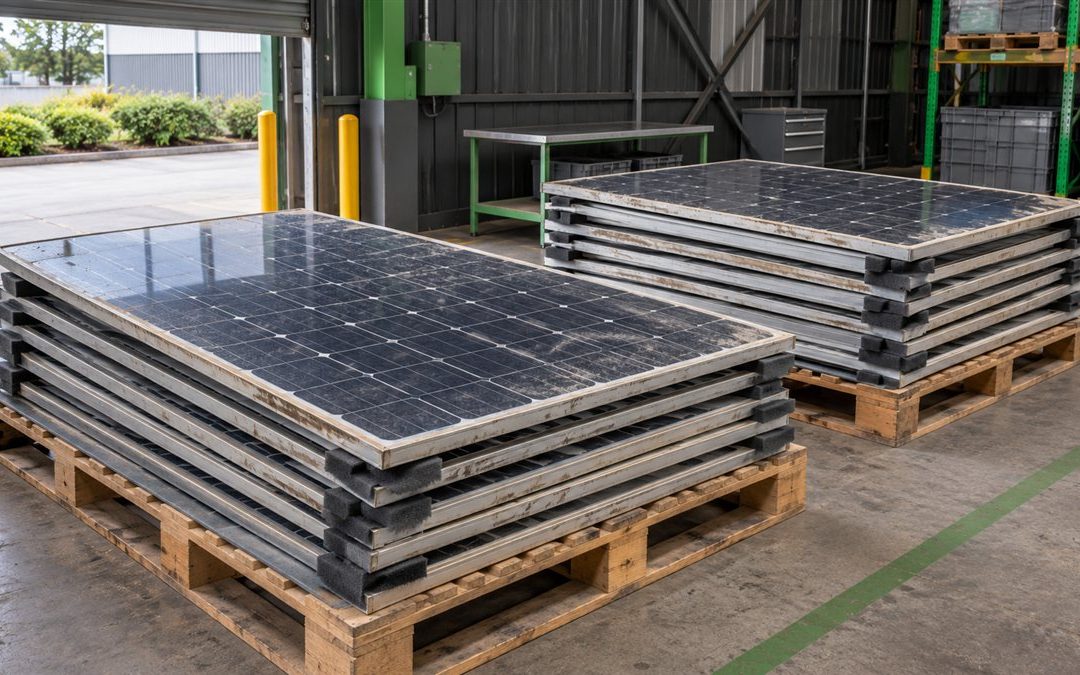
A typical panel is mostly glass, held in an aluminium frame, with a thin layer of silicon cells, copper wiring, small amounts of silver, a plastic backsheet and a junction box. The layers are bonded together with a polymer film so the panel survives decades of weather. That bonding is what makes recycling hard.
NSW says more than 95 per cent of a solar panel is recyclable. In practice, much current recycling is what the NSW EPA calls “basic recycling”, where the frame is removed and the rest of the panel is treated as waste. Recovering the glass, silicon, silver and copper takes more specialised mechanical, thermal or chemical processing, and only a few facilities in Australia do it.
| Component | How easily it is recovered |
|---|---|
| Aluminium frame | Easily removed and recycled. This is the part most often recovered. |
| Junction box and cables | Removed by hand and recycled with other cable and copper scrap. |
| Glass | The largest part by weight. Recoverable once separated from the laminate. |
| Silicon cells, silver and copper | Valuable, but bonded into the laminate. Needs specialised processing. |
| Polymer layers and backsheet | Hard to recycle. Often burnt off or sent to waste. |
Can you put solar panels in landfill in Victoria?
No. Victoria’s e-waste landfill ban, which has applied since 1 July 2019, covers anything with a plug, battery or cord, and solar panels are included. Solar Victoria’s guidance says the Waste Management Policy (e-waste) “prohibits any form of e-waste from entering landfill” and that “solar panels must be taken to a lawful e-waste collection point or solar PV recycler.”
Panels must only be recycled at facilities with EPA Victoria authorisation to sort, store or recover e-waste. Solar Victoria also warns that exporting panels that are non-compliant, unsafe or considered e-waste may be illegal. For the wider rules, see our explainer on Victoria’s e-waste landfill ban.
Victoria is still one of the few places in Australia where panels are banned from landfill. In most other states, end-of-life panels can still legally go to landfill, which is one reason governments are now working on a national approach.
What is NSW’s solar panel stewardship scheme?
In September 2026 the NSW EPA released the draft Product Lifecycle Responsibility Amendment (Photovoltaic Panels) Regulation 2026 for public comment. It would be Australia’s first mandatory product stewardship scheme for solar panels. Under the draft:
- the NSW EPA would begin a process to enter an agreement with a product stewardship organisation to run the scheme
- brand owners supplying solar panels into NSW would have to meet product stewardship requirements
- suppliers would pay fees to fund collection and recycling
- the scheme would cover rooftop panels on homes and businesses, and solar farm panels at end of life
Consultation closed at 5pm on Monday 16 November 2026. The NSW EPA will review the feedback and publish a consultation outcomes report before finalising the regulation. It says that once finalised, the scheme is expected to commence in early 2028. It will sit under the same law as the NSW battery stewardship scheme.
NSW is also leading national work. In August 2025, energy and climate ministers agreed that NSW would lead preliminary work, with other jurisdictions, on a Regulatory Impact Statement for a national mandatory scheme.
What happened to the national solar panel recycling pilot?
On 16 January 2026 the federal government announced $24.7 million over three years for a National Solar Panel Recycling Pilot. According to DCCEEW, the pilot aims to collect up to 250,000 panels from around 100 sites, from homes, businesses and a few solar farms. A pilot administrator would have contracted collection and recycling providers and paid them according to location. The data collected was to inform a future national product stewardship proposal.
The tender for a pilot administrator closed on 24 April 2026. DCCEEW had said the pilot was proposed to start in mid-2026. On 15 May 2026, after receiving a complaint about the procurement process, the department suspended it. RenewEconomy reported in July that a departmental letter said the suspension was “required under the Government Procurement (Judicial Review) Act 2018 (Cth)” while the complaint was investigated. In September the department told RenewEconomy: “The procurement remains suspended.”
Recyclers have said the delay is hurting them. Some had been collecting and storing panels in expectation of the pilot. In August an industry group asked the government to issue a public interest certificate, which would allow the procurement to go ahead while the complaint is investigated. On 10 November 2026 DCCEEW lifted the suspension after a public interest certificate was issued, then cancelled the procurement without awarding a contract. It cited “changes in the industry since the release of the ATM” (the approach to market). The government says it is now considering next steps for the pilot.
What is the federal solar panel inquiry looking at?
On 19 January 2026, the Minister for the Environment and Water, Senator Murray Watt, referred an inquiry into solar panel reuse and recycling to the House of Representatives Standing Committee on Climate Change, Energy, Environment and Water, chaired by Anne Urquhart MP. The committee is examining how end-of-life panels are handled now, and the options for reuse, recycling, product stewardship, data and traceability.
The committee has held public hearings in Melbourne, Sydney and Canberra. DCCEEW appeared again on 28 October 2026 to discuss a circular economy for solar panels, including diverting panels from landfill and reducing stockpiling and export of used panels. The committee had not tabled a report as at 19 November 2026.
How does Australia compare with other countries?
The European Union has treated solar panels as electrical and electronic waste since its 2012 WEEE Directive, which makes producers responsible for financing their collection and recycling. Australia has no national equivalent yet. The NSW scheme and the inquiry are steps towards one, while the federal pilot’s future is uncertain after its procurement was cancelled.
| Measure | Who | Status (19 November 2026) |
|---|---|---|
| E-waste landfill ban covering solar panels | Victoria | In force since 1 July 2019 |
| Mandatory solar panel stewardship scheme | NSW | Draft regulation; consultation closed 16 November 2026; regulation being finalised; expected start early 2028 |
| National Solar Panel Recycling Pilot | Federal (DCCEEW) | Procurement cancelled 10 November 2026; government considering next steps |
| Inquiry into solar panel reuse and recycling | House of Representatives committee | Hearings held; report not yet tabled |
| National mandatory scheme | All governments, NSW leading | Regulatory Impact Statement work under way; model not finalised |
What should you do with old solar panels?
Until a national scheme exists, the responsibility sits mostly with whoever removes the panels. A few practical steps apply whether you are a household or a business:
- Ask your installer first. Many installers arrange removal and recycling of old panels as part of an upgrade. Ask where the panels will go and whether the recycler is authorised by EPA Victoria.
- Check whether they can be reused. Working panels removed during an upgrade may still have years of output left. Reuse should only happen after electrical safety testing by a qualified person.
- Use a lawful e-waste collection point or a solar PV recycler. Your local council can tell you the nearest site that accepts panels. Not every transfer station does.
- Keep inverters and batteries separate. Inverters are e-waste too, and home batteries carry fire risks of their own. Ask the recycler how each should be handled.
- Do not leave panels out for hard rubbish unless your council confirms it accepts them.
For a step-by-step guide, see our article on disposing of old solar panels and inverters.
Frequently asked questions
Are solar panels recycled in Australia?
Some are, but not many. The federal government said in January 2026 that only 17 per cent of solar panels were being recycled. Often only the aluminium frame is recovered.
Can solar panels go in landfill in Victoria?
No. Solar panels are e-waste under Victoria’s landfill ban. They must go to a lawful e-waste collection point or a solar PV recycler authorised by EPA Victoria.
Is there a national solar panel recycling scheme?
Not yet. All governments have agreed to work towards one, with NSW leading the Regulatory Impact Statement. NSW has consulted on its own mandatory scheme, which is expected to start in early 2028.
What happened to the $24.7 million solar recycling pilot?
Its procurement was suspended in May 2026 after a complaint about the process to appoint a pilot administrator. On 10 November 2026 the government cancelled the procurement without awarding a contract, and it says it is considering next steps.
Who pays for solar panel recycling?
Today it is usually the owner or the installer removing the panels. Under the proposed NSW scheme, suppliers would pay fees to a product stewardship organisation to fund collection and recycling.
Replacing equipment at your workplace?
If you have panels, inverters or other electronic equipment to retire, you can request a quote for a collection or email info@ewastevictoria.net.au.
Related reading
- Disposing of Old Solar Panels and Inverters
- Victoria’s E-Waste Landfill Ban Explained
- Product Stewardship and E-Waste in Australia
- Extended Producer Responsibility for Electronics
- The Future of E-Waste Regulation in Australia
Sources
- DCCEEW, Solar panels: National Solar Panel Recycling Pilot (page last updated 11 November 2026).
- Joint media release, Treasurer, Minister for Climate Change and Energy, and Minister for the Environment and Water, Labor pilots national solar panel recycling program (16 January 2026).
- NSW EPA, Draft Solar Panels Regulation (consultation closed 16 November 2026).
- NSW Department of Climate Change, Energy, the Environment and Water, NSW leads the way on a national solar panel reuse and recycling scheme (18 August 2025).
- Solar Victoria, Manage end-of-life solar PV (updated 22 July 2026).
- House of Representatives Standing Committee on Climate Change, Energy, Environment and Water, Committee to shine light on solar waste and reuse opportunities (2 October 2026), and Committee to discuss progressing a national solar panel circular economy (October 2026).
- RenewEconomy, Australia’s solar PV recycling plans on hold after flagship pilot project suspended (17 July 2026) and Solar recyclers call on government to reboot pilot scheme (18 September 2026).
- pv magazine, Australia cancels solar panel recycling pilot, considers next steps (12 November 2026).