
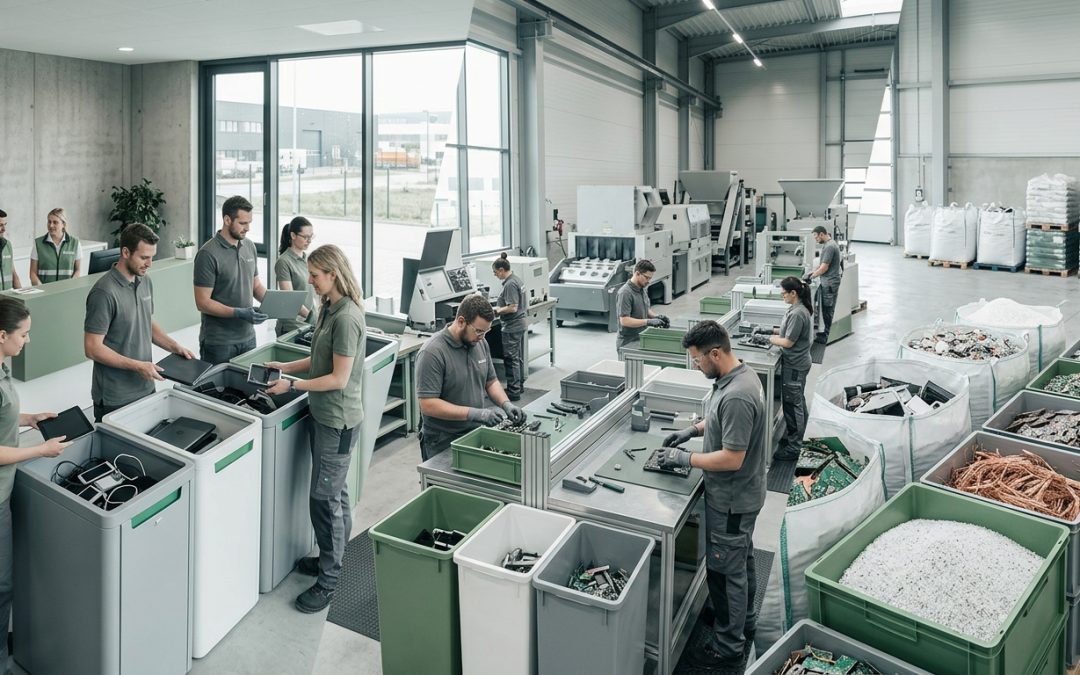
What Really Happens After You Drop Off Your E-Waste
You’ve done the right thing: packed up your old electronics, driven them to a collection point, and handed them over. But what happens next? For most people, the journey of their old devices ends at the drop-off. The reality is that it’s just beginning, and the process that follows is far more sophisticated and fascinating than most people realise.
Understanding this journey matters because it shows why proper recycling is worth the effort. Your old phone doesn’t just disappear. Its materials go on a complex journey through industrial processes that recover valuable resources and prevent hazardous substances from causing harm.
Stage 1: Collection and Sorting
The first stop for your old electronics is a sorting facility. Whether collected from a council drop-off point, a retailer take-back program, or a commercial e-waste service, everything goes through an initial triage process that determines what happens next.
Trained staff sort incoming items into broad categories: computers and laptops, mobile phones, monitors and screens, printers and peripherals, household appliances, batteries (separated immediately for safety), and cables and accessories.
During this stage, devices are also assessed for reuse potential. A working laptop might be worth refurbishing rather than recycling. A functional phone could go to a program that provides devices to people in need. Reuse is always the preferred outcome over recycling because it preserves the energy and resources that went into manufacturing the device in the first place.
Items identified for reuse go through data destruction, testing, refurbishment, and quality checks before being resold or donated. Everything else moves to the next stage.
Stage 2: Manual Disassembly
Before any mechanical processing begins, many devices go through manual disassembly. Skilled workers remove components that need separate handling, including batteries (which are fire hazards if shredded), toner and ink cartridges, CRT glass (which contains lead), mercury-containing components like older LCD backlights, and easily accessible valuable components like copper heat sinks.
This manual step is crucial for safety and material recovery. Lithium-ion batteries that enter a shredder can ignite and cause facility fires, which is a genuine risk that e-waste recycling facilities take extremely seriously. Separating hazardous components also ensures they go through appropriate specialist processing rather than contaminating other material streams.
Stage 3: Mechanical Processing
Once hazardous and specialist components are removed, the remaining material goes through mechanical processing. This typically involves shredding the devices into small pieces, followed by a series of separation processes that sort the resulting material by type.
Industrial shredders break devices down into fragments a few centimetres across. The shredded material then passes through several separation technologies. Magnetic separation pulls out ferrous metals like steel. Eddy current separation recovers non-ferrous metals like aluminium and copper. Density-based separation (using air tables or water-based systems) sorts materials by weight. Optical sorting uses cameras and sensors to identify and separate different types of plastics.
The output from this stage is several separated material streams: ferrous metals, non-ferrous metals, precious-metal-rich fractions (mostly from circuit boards), plastics sorted by type, glass, and residual material that can’t be economically recovered.
Stage 4: Refining and Smelting
The separated material streams each go to specialist processors for further refining. This is where the real transformation happens, turning what was waste into raw materials ready for manufacturing.
Ferrous metals (steel, iron) go to steel mills where they’re melted and reformed into new steel products. Steel is infinitely recyclable without losing quality, making it one of the most efficiently recycled materials in e-waste.
Non-ferrous metals like copper and aluminium go to specialist smelters. Copper recovered from e-waste is refined to the same purity as virgin copper and goes back into wire, cable, and electronic components. Aluminium is remelted and used in new products, requiring only 5% of the energy needed to produce aluminium from raw bauxite ore.
The most valuable fraction is the precious-metal-rich material from circuit boards. This goes to specialist precious metal refineries where complex chemical and thermal processes extract gold, silver, platinum, and palladium. A single tonne of circuit boards can yield more gold than several tonnes of gold ore from a mine.
Stage 5: Plastic Recycling
Plastics from e-waste present a more complex challenge than metals. Electronics contain many different types of plastic, and they need to be separated by type before they can be recycled. Some contain flame retardants that require careful handling.
Common plastics like ABS, polycarbonate, and polypropylene can be granulated and sold to manufacturers as recycled feedstock. They might end up in new electronics housings, automotive parts, construction materials, or consumer products.
Plastics containing brominated flame retardants require special processing. In some cases, the flame retardants can be removed and the base plastic recycled. In others, the material is used for energy recovery in controlled incineration facilities with proper emissions controls. The industry is continuously developing better techniques for handling these more challenging plastic streams.
Stage 6: Battery Processing
Batteries removed during disassembly go through their own dedicated recycling stream. Lithium-ion battery recycling is one of the fastest-evolving areas of the recycling industry, driven by the explosive growth in batteries from electric vehicles, portable electronics, and energy storage systems.
The process typically involves discharging the batteries to a safe voltage, mechanical shredding in a controlled environment, separation of the “black mass” (a mixture of valuable cathode and anode materials), and hydrometallurgical or pyrometallurgical processing to recover lithium, cobalt, nickel, and manganese.
Recovered battery materials go directly back into new battery manufacturing. Cobalt and lithium in particular are critical minerals with supply chain concerns, making their recovery from old batteries both environmentally and strategically important.
Stage 7: Back Into the Supply Chain
The final stage of the journey is where recycled materials re-enter the manufacturing supply chain. Recovered metals and plastics become the raw materials for new products, closing the loop on what would otherwise be a one-way trip from mine to landfill.
Recycled copper from old electronics might end up in new wiring, plumbing, or electronic components. Gold recovered from circuit boards goes back into connectors and contacts in new devices. Recycled aluminium becomes new cases, frames, and heat sinks. Steel becomes structural components, vehicles, or construction materials.
This circular flow reduces the need for virgin mining, cuts energy consumption, and avoids the environmental damage associated with extracting and processing raw materials. Recycled metals are functionally identical to virgin metals, so there’s no quality compromise in using them.
- Recycled aluminium uses 95% less energy than virgin production
- Recycled copper uses 85% less energy than mining new copper
- Recycled steel uses 74% less energy than producing steel from iron ore
- Precious metal recovery from e-waste is far more concentrated than mining ore
What Doesn’t Get Recovered
No recycling process is 100% efficient. Typically, 5-10% of material by weight from e-waste processing ends up as residual waste that goes to engineered landfill. This includes mixed material fragments that can’t be economically separated, some contaminated plastics, dust and fines from shredding processes, and materials with no current recovery pathway.
The industry continuously works to reduce this residual fraction. Advances in sorting technology, new chemical recovery processes, and growing markets for secondary materials are all pushing recovery rates higher. What was waste five years ago may have a recovery pathway today.
The Full Circle
From your hands to the collection point, through sorting, disassembly, shredding, refining, and back into new products, the journey of recycled electronics is a complex industrial process that takes real effort and investment. But the outcome is worth it: valuable resources recovered, hazardous materials safely managed, and the environmental damage of virgin mining avoided.
Understanding this process helps explain why recycling your old electronics is so much more than a feel-good gesture. It’s a practical contribution to a more sustainable industrial system. For a comprehensive overview of the full lifecycle, explore our guide to what happens to old electronics and learn about the circular economy for electronics.
EWV helps Victorian businesses manage e-waste and IT asset disposal compliantly and sustainably — including collection, certified data destruction, and recycling. Contact us for a free quote.