
Why Tape Media Still Matters for Data Destruction
Despite the shift toward disk and cloud storage, magnetic tape remains a widely used medium for data backup, archival storage, and disaster recovery. Formats like LTO (Linear Tape-Open), DLT, and enterprise cartridge systems continue to play a critical role in many organisations’ data management strategies, particularly in sectors that require long-term retention of large data volumes.
When tape media reaches end of life or is no longer needed, the data it contains requires the same rigorous destruction as any other storage medium. Tape presents its own unique challenges and considerations that organisations need to understand.
Types of Tape Media in Use
The most common tape format in current use is LTO (Linear Tape-Open), with LTO-9 offering up to 18 TB of native capacity per cartridge. Older LTO generations (LTO-4 through LTO-8) are also still in circulation, particularly in backup rotation schemes where tapes are retained for years.
Other formats that organisations may need to dispose of include DLT and SDLT cartridges, IBM 3592 enterprise cartridges, Oracle T10000 cartridges, DAT/DDS cartridges, and older formats like 9-track reels and QIC cartridges. Each format has slightly different physical characteristics, but the fundamental data destruction approaches are similar across all magnetic tape types.
Destruction Methods for Tape Media
Degaussing is one of the most effective methods for tape media destruction. Because tape is a magnetic medium, exposing it to a sufficiently powerful magnetic field completely randomises the data stored on it. The degausser must be rated for the coercivity of the tape format being processed. Modern LTO tapes have higher coercivity than older formats, so a degausser rated for LTO-7 or above should be used for current-generation media.
Degaussing is fast, typically processing a cartridge in seconds, and works regardless of whether the tape is functional. It does not physically destroy the cartridge, so degaussed tapes should be clearly labelled or physically damaged after treatment to prevent accidental reuse.
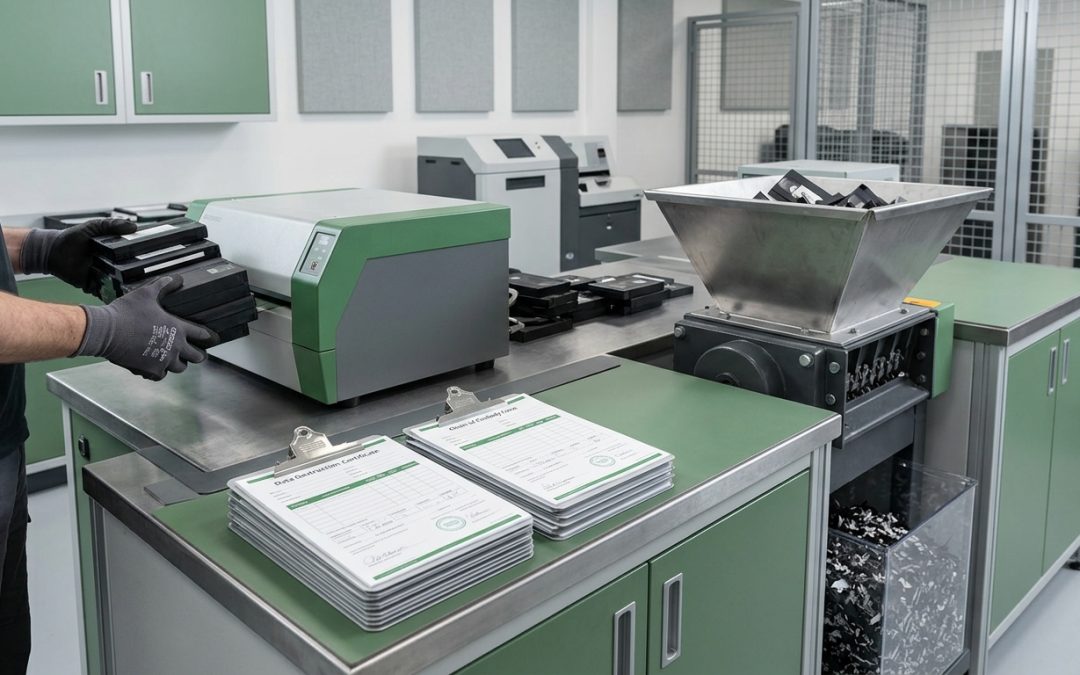
Physical shredding reduces the tape cartridge to small fragments, destroying both the housing and the tape medium inside. Industrial shredders designed for electronic media can process tape cartridges quickly and produce waste of a size that makes reconstruction impossible. This method provides the highest level of assurance and produces visible evidence of destruction.
Incineration completely destroys the tape medium through high-temperature burning. While effective, incineration must be carried out at licensed facilities that can manage the emissions from burning plastics and magnetic media. Environmental regulations in Victoria and across Australia restrict where and how electronic waste can be incinerated.
Software overwriting is possible for functional tape media. The tape is loaded into a compatible drive and overwritten with new data across its entire length. This method follows the same principles as NIST 800-88 sanitisation for disk media. However, it requires a functioning tape drive compatible with the specific cartridge format, which can be a challenge for older formats where drives may no longer be available.
Challenges Specific to Tape Destruction
Volume is often the biggest practical challenge. Organisations that have used tape for backup and archival may have hundreds or thousands of cartridges that need to be destroyed when a retention period expires or when the tape library is decommissioned. Processing these volumes requires either dedicated equipment or a relationship with a certified destruction provider.
Mixed formats complicate the process when an organisation has accumulated tapes across multiple generations and technologies. Different formats may require different degausser ratings, and some legacy formats may not have compatible drives available for software overwriting.
Off-site storage adds logistical complexity. Many organisations store backup tapes at off-site locations, either at dedicated tape vaulting facilities or at disaster recovery sites. These tapes must be recalled, inventoried, and securely transported before destruction can take place. The chain of custody for off-site tapes requires particular attention.
Data classification across tape sets can be unclear. A single tape in a backup rotation may contain data from many different systems and sensitivity levels. When in doubt, the destruction method should match the highest sensitivity level that may be present on the tape.
Best Practices for Tape Destruction
Maintain a complete inventory of all tape media, including tapes at off-site locations. This inventory should include the tape format, date range of data, data classification, and current storage location. Without a comprehensive inventory, there is a risk that tapes will be overlooked during a destruction project.
Verify retention obligations before destroying any tape media. Backup tapes may be the only copy of data that is subject to retention requirements, legal holds, or regulatory preservation obligations. Cross-reference the tape inventory against your data retention schedule and any active legal holds before authorising destruction.
Use certified destruction methods appropriate to the data sensitivity. For most commercial data, degaussing with an appropriately rated degausser is sufficient. For highly sensitive or classified data, combine degaussing with physical shredding for maximum assurance.
Document everything. For each tape destroyed, record the cartridge identifier (barcode or serial number), the destruction method used, the date of destruction, and the person who performed or witnessed the destruction. Certificates of destruction should be generated and retained as compliance records.
Tape media destruction may not attract the same attention as hard drive or SSD disposal, but the data on these cartridges can be just as sensitive. Treating tape with the same rigor as any other storage medium protects your organisation and satisfies compliance requirements. For a comparison of all destruction methods, see our guide to hard drive destruction methods compared.
EWV helps Victorian businesses manage e-waste and IT asset disposal compliantly and sustainably — including collection, certified data destruction, and recycling. Contact us for a free quote.