
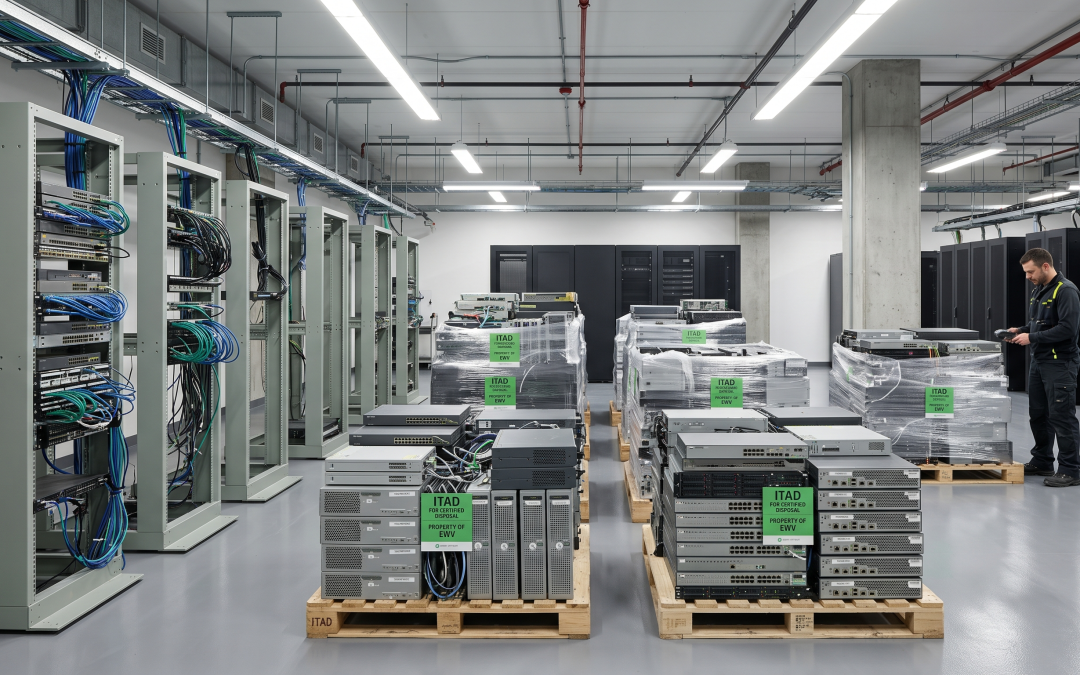
Telecommunications equipment presents unique ITAD challenges that go beyond standard IT disposal. From PBX systems and VoIP infrastructure to mobile base stations and fibre optic equipment, telecom hardware stores sensitive communication data, network configurations, and customer information that requires careful handling at end of life.
What Telecom Equipment Contains
Telecommunications equipment encompasses a broad range of devices and systems. Enterprise phone systems, including both legacy PBX hardware and modern IP-based platforms, store call records, voicemail messages, extension configurations, and sometimes call recordings. VoIP equipment including SIP servers, session border controllers, and media gateways contains SIP credentials, call routing tables, and network configuration data.
Carrier-grade equipment such as switches, routers, and multiplexers in telecommunications provider networks contains detailed network topology data and may store traffic metadata. Mobile infrastructure including base stations (macro cells, small cells), radio equipment, and backhaul systems stores radio configurations, frequency allocations, and network management credentials. And video conferencing systems retain meeting records, contact directories, and connection credentials.
Data Security Risks
The data on telecommunications equipment poses several specific risks. Call detail records (CDRs) reveal who communicated with whom, when, and for how long. This metadata can be highly sensitive, particularly in government, legal, and corporate espionage contexts. Voicemail recordings may contain confidential business discussions, legal advice, or personal information.
Network configuration data from telecom equipment reveals the architecture of communication systems, including redundancy paths, capacity limits, and security measures. For telecommunications providers, this data is commercially sensitive and potentially relevant to national security.
Authentication credentials stored on telecom equipment could provide access to active communication systems if not properly changed or decommissioned. SIP credentials, SNMP community strings, and management console passwords all need to be addressed.
Sanitisation Challenges
Telecom equipment often uses proprietary operating systems and storage formats that do not support standard data wiping tools. Legacy PBX systems may use custom hardware with no provision for secure data erasure. Modern IP-based systems are more similar to standard IT equipment and may support conventional wiping approaches.
For legacy telecom hardware, the sanitisation approach typically involves using the manufacturer’s built-in reset procedures to remove configuration data, manually clearing call logs, voicemail, and recorded data through the system’s administration interface, removing any removable storage media for separate processing, and consulting the manufacturer’s documentation for any additional data storage locations.
Where software-based sanitisation cannot be verified, physical destruction of storage components provides definitive assurance. This is particularly relevant for older telecom equipment where the extent and location of data storage may not be fully documented.
Carrier and Enterprise Differences
The approach to telecom equipment ITAD differs between telecommunications carriers and enterprise users. Carriers deal with larger volumes of specialised equipment, much of which has significant resale value in secondary markets. Carrier equipment may also be subject to specific regulatory requirements around network security and customer data protection.
Enterprise users typically deal with smaller volumes of communications equipment, often as part of broader IT disposal projects. The key for enterprises is ensuring telecom equipment is included in their overall ITAD policy rather than treated as a separate category that falls between IT and facilities management.
Value Recovery
Certain categories of telecom equipment hold strong resale value. Enterprise IP phone handsets from major brands (Cisco, Poly, Yealink) have active secondary markets. Enterprise PBX and VoIP infrastructure can be remarketed to smaller organisations. Carrier-grade networking equipment from established manufacturers retains value well. And specialised test equipment used in telecom environments is often in demand.
Legacy equipment with limited market demand, such as older analogue PBX systems, typically has minimal resale value and is better directed to material recycling.
Environmental Handling
Telecom equipment contains the standard range of electronic materials requiring proper recycling. Additionally, some telecom equipment may contain backup batteries (often lithium or sealed lead-acid), older equipment may contain hazardous materials in displays or indicators, and cable infrastructure (copper, fibre) has recycling value but needs proper separation.
All electronic components must be handled in accordance with e-waste regulations, and hazardous components must be directed to appropriate treatment facilities.
Planning Telecom Decommissioning
When decommissioning telecom systems, coordinate closely with your communications team to ensure replacement systems are fully operational before removing old equipment, all data (call records, voicemail, configurations) has been migrated or archived as required, phone numbers and routing have been transferred to new platforms, and users have been trained on replacement systems. The technical complexity of telecom systems means that decommissioning should be planned methodically, with clear rollback procedures in case issues arise during the transition.
EWV provides NIST 800-88 certified data destruction for Victorian businesses, covering software-based erasure and physical destruction with full chain-of-custody documentation. Request a quote to discuss your requirements.