
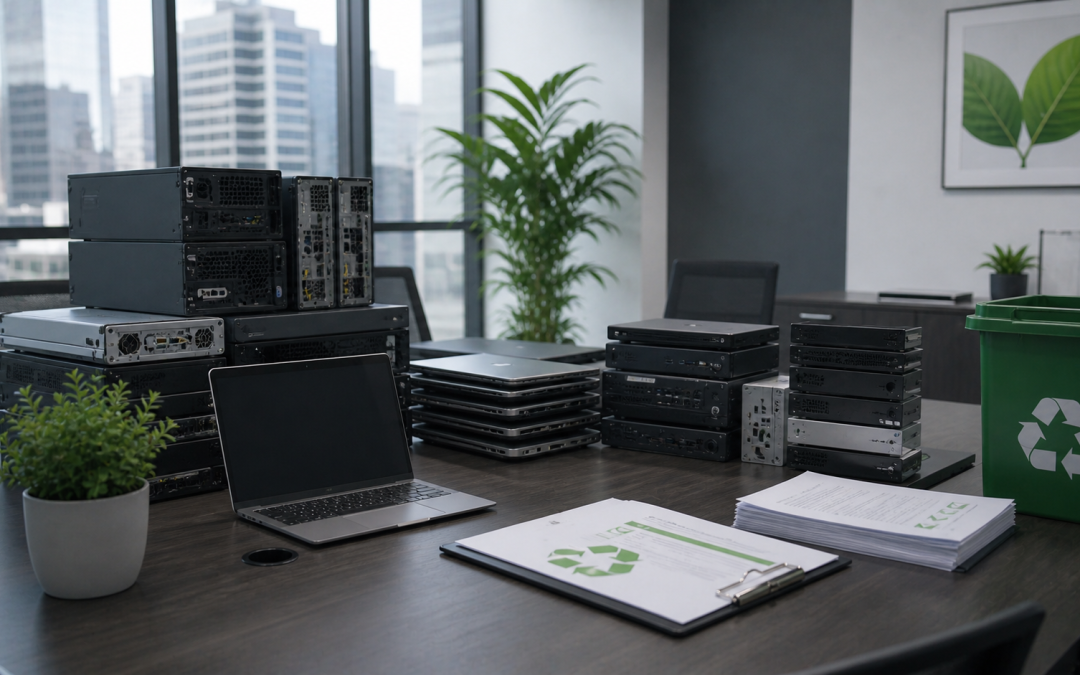
Telecommunications companies operate some of the most extensive technology networks in the country, with equipment deployed across exchange buildings, mobile towers, data centres, and customer premises. The volume of electronic equipment flowing through a telco’s operations is enormous, and as networks evolve through technology generations, from 3G through 4G to 5G and beyond, the disposal of legacy equipment represents both a significant environmental challenge and a major ESG reporting opportunity.
The Scale of Telco E-Waste
A major telecommunications provider operates millions of individual technology components across its network. Base station equipment on thousands of mobile towers, switching and routing equipment in hundreds of exchange buildings, customer premises equipment including modems and routers deployed to millions of customers, and enterprise-grade equipment installed at business customer sites all have finite operational lives.
Network generation transitions amplify this already substantial volume. When a telco decommissions 3G infrastructure to repurpose spectrum for 5G, entire networks of equipment become obsolete simultaneously. The logistics of collecting, processing, and responsibly disposing of this volume require industrial-scale planning.
Network Generation Transitions
Technology transitions are the defining e-waste events for telecommunications companies. Each generation shift involves deploying new equipment while decommissioning the old across the entire network footprint. These transitions take years to complete, creating sustained volumes of legacy equipment requiring disposal.
Forward-thinking telcos plan the decommissioning pathway alongside the deployment schedule for new technology. This parallel planning ensures that legacy equipment is collected systematically as it is replaced, rather than accumulating at sites or being disposed of through ad hoc channels.
Customer Premises Equipment
Modems, routers, set-top boxes, and other customer premises equipment (CPE) represent a unique e-waste challenge. Millions of devices are deployed to customer homes and businesses, and when services are cancelled or equipment is upgraded, these devices need collection and processing.
Some telcos operate CPE return programs where customers send back old equipment for refurbishment and redeployment. These programs reduce both procurement costs and e-waste volumes while demonstrating circular economy practices. The challenge is achieving high return rates, as many customers simply store old devices in drawers rather than returning them.
Tower and Exchange Equipment
Network infrastructure equipment tends to be larger, heavier, and more material-intensive than consumer devices. Base station equipment, power systems, cooling equipment, and networking hardware from tower sites and exchanges contain significant quantities of metals including copper, aluminium, and steel, as well as electronic components with precious metal content.
The material recovery potential from network infrastructure is substantial. Working with specialist processors who can handle large-scale equipment and maximise material recovery rates ensures both environmental and economic value from decommissioned network assets.
ESG Reporting at Telco Scale
Telecommunications companies are major reporters under ESG frameworks, with detailed disclosures expected by investors, regulators, and customers. E-waste data at telco scale provides compelling environmental metrics: thousands of tonnes processed, high material recovery rates, significant CO2e avoidance, and demonstrated circular economy practices through CPE refurbishment programs.
These metrics sit alongside energy consumption, emissions, and digital inclusion data in comprehensive telco ESG reports. The specificity and scale of telco e-waste data can be a standout element that differentiates strong ESG performers from peers.
Regulatory Compliance
Telecommunications companies must comply with environmental regulations across every jurisdiction where they operate equipment. In Victoria, the e-waste landfill ban applies to all electronic equipment regardless of whether it is consumer or infrastructure grade. National regulations around hazardous materials in electronic equipment also apply to network hardware.
Product stewardship obligations may also apply, requiring telcos to take responsibility for the end-of-life management of products they supply to customers. These obligations are evolving and likely to expand, making proactive end-of-life management a strategic risk mitigation measure.
For more on ESG reporting frameworks, see our guide on ESG reporting and e-waste for Australian businesses.
EWV helps Victorian businesses manage e-waste and IT asset disposal compliantly and sustainably — including collection, certified data destruction, and recycling. Contact us for a free quote.