
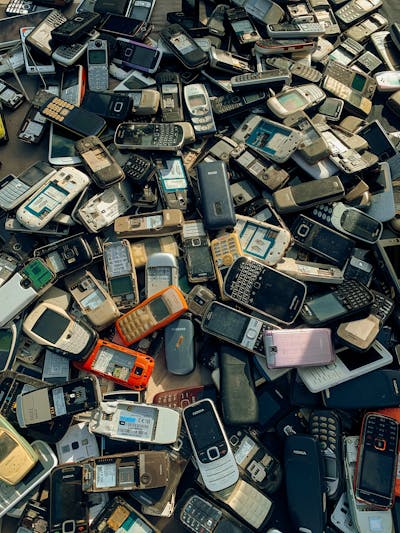
A Chatham House report published this month makes a pointed observation about the rare earth trade dispute between the US and China: while politicians negotiate over mining rights and tariffs, enormous reserves of the minerals they need are sitting inside discarded electronics.
The analysis focuses on the US. But the same logic applies in Australia.
What Is Actually Inside Decommissioned IT Hardware
Hard drives contain neodymium-iron-boron magnets. Circuit boards carry gold, silver, palladium, and copper. Laptop batteries hold lithium and cobalt. Screens contain indium and gallium.
These are not trivial quantities. In 2022, the metals contained in global e-waste were valued at around USD 90 billion. Less than one-third was actually recovered. The rest was lost to landfill, illegal export, or processing that failed to extract full material value.
In Victoria, sending e-waste to landfill has been illegal since 1 July 2019. But lawful disposal and high-value material recovery are not the same thing. The process matters. The provider matters.
The Critical Mineral Gap Is a Chain of Custody Problem
The reason so much recoverable material is lost from end-of-life electronics is the same reason data incidents follow poor ITAD processes: chain of custody breaks down.
Once equipment leaves an organisation without documented tracking, there is no visibility into where it goes or what happens to the materials inside. No guarantee on data destruction. No guarantee the cobalt in the batteries or the rare earth content in the drive magnets ends up in an accountable recycling stream.
For critical minerals to re-enter domestic supply chains, ITAD providers need to operate with full material traceability. That means serial-level asset tracking, documented destruction outcomes, and downstream partner accountability. It is exactly the kind of framework that AS/NZS 5377 compliance and NIST 800-88 Rev. 2 data destruction standards push organisations toward.
Why ESG Disclosure Is Raising the Bar
Corporate Australia’s exposure to ESG reporting requirements has changed the stakes. GRI 306 waste disclosure and CDP reporting now expect documented evidence of waste outcomes, not assertions.
The Chatham House report notes that Apple has already moved to close this loop. Several product lines now use 100% recycled rare earth elements in all magnets. Dell runs closed-loop processes for hard drive magnet recovery. These are not pilot programs. They are large-scale operations that treat e-waste as a materials input, not a disposal problem.
Australian businesses are not far behind on expectations. Scope 3 emissions accounting, director liability for environmental harm, and supply chain due diligence requirements are converging. How an organisation handles end-of-life IT is a governance question now, not a facilities question.
What Responsible ITAD Looks Like in Practice
EWV’s CircularTrack platform documents every asset from collection through secure data destruction to verified material recovery. Clients receive chain of custody records that satisfy ESG audit requirements and support CO2e reporting.
EWV operates in alignment with AS/NZS 5377, NIST 800-88 Rev. 2, ISO 14001 for environmental management, and ISO 27001 for information security, with full certification on the roadmap.
That alignment means the materials leaving your organisation through EWV’s process are tracked, accounted for, and directed into verified downstream recovery streams. The neodymium in your old drives, the copper in your decommissioned servers, the lithium in end-of-life laptops: all documented.
The Bottom Line for IT and Sustainability Teams
If your organisation is planning an IT refresh, a data centre decommission, or a regular device rotation, the question is not only about data security.
It is also about where those materials go.
Responsible ITAD is how Australian businesses contribute to domestic critical mineral recovery rather than exporting the problem.
Contact EWV to discuss how CircularTrack documents your asset disposition from collection to verified material outcome.
Based on: Chatham House, “Rare earths are on Trump’s agenda in China. But US electronic waste offers an untapped source at home”, May 2026.