
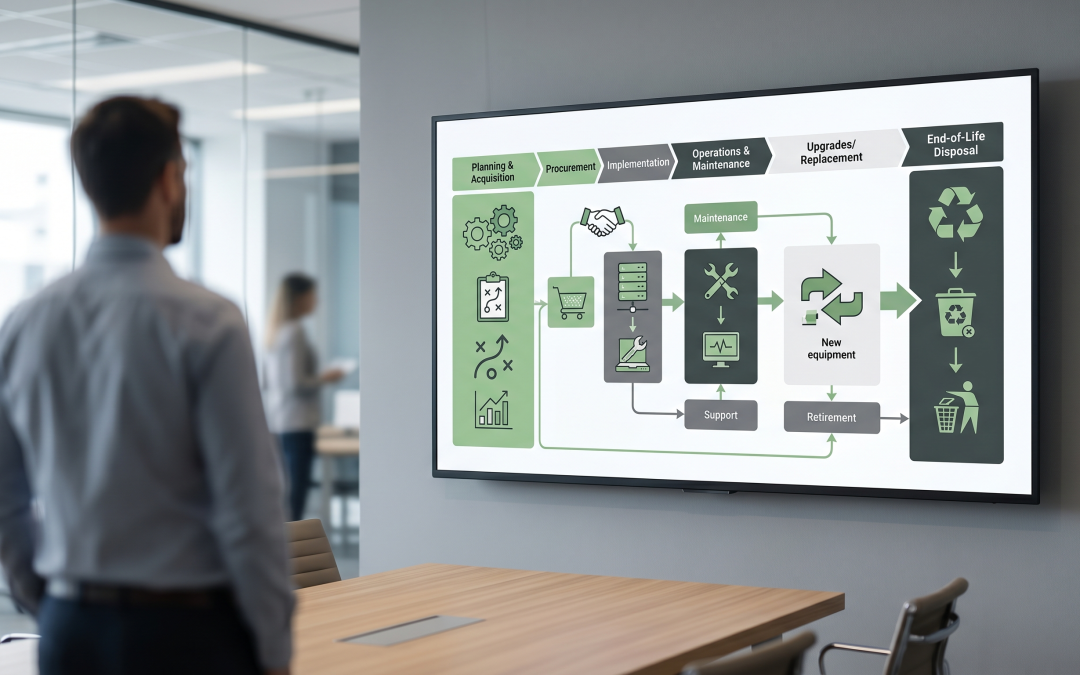
Total cost of ownership (TCO) is a familiar concept in IT procurement, but most TCO calculations stop short of including end-of-life costs and value recovery. This omission means organisations are making procurement and lifecycle decisions based on incomplete financial data. Including disposal in your TCO model leads to better purchasing decisions, more realistic budgets, and sometimes surprising conclusions about the true cost of different technology choices.
What TCO Usually Includes
A standard IT TCO calculation typically covers the purchase price or lease cost, deployment and configuration costs, software licensing, ongoing maintenance and support, power and cooling costs (particularly for data centre equipment), productivity impact during the useful life, and upgrade and refresh costs during the lifecycle.
What it typically misses is everything that happens after the equipment is no longer needed: the cost of decommissioning and preparing equipment for disposal, data destruction costs, transport and processing fees, storage costs if equipment is stockpiled before disposal, staff time to manage the disposal process, environmental compliance costs, and any value recovery that offsets these costs.
Why End-of-Life Costs Matter
For individual devices, end-of-life costs may seem small relative to the purchase price. But for an organisation managing thousands of devices through regular refresh cycles, these costs are significant in aggregate. A $20 per-device disposal cost multiplied by 2,000 devices is $40,000 per refresh cycle. Add in the value of staff time, storage costs during stockpiling, and the potential financial impact of a data breach from improper disposal, and the numbers become material.
More importantly, including end-of-life costs in TCO can change the relative attractiveness of different technology options. A cheaper device that is harder or more expensive to dispose of securely may have a higher true TCO than a premium device that is easier to sanitise and has better resale value.
Building End-of-Life into TCO Models
To create a complete TCO model, add disposal-related cost categories to your existing framework. Direct disposal costs include ITAD provider fees for collection, data destruction, and recycling. For most organisations with established ITAD programs, these costs are predictable and can be estimated based on historical data or provider quotes.
Indirect disposal costs include internal staff time for asset auditing, inventory management, and disposal coordination. Storage costs for equipment between decommissioning and collection. Administrative costs for documentation and compliance management. And any remediation costs if disposal processes fail (such as the cost of responding to a data breach).
Value recovery should be modelled as a cost offset. Based on the equipment type, expected useful life, and secondary market conditions, estimate the resale value at the planned disposal date. Your ITAD provider can help with these estimates based on current market data and their experience with similar equipment.
How End-of-Life Costs Vary by Equipment Type
Different equipment categories have very different end-of-life cost profiles. Laptops have moderate disposal costs and the highest value recovery potential, often resulting in a net-positive or near-neutral end-of-life position for recent equipment. Desktops have similar disposal costs but lower value recovery, resulting in a net disposal cost. Servers have higher per-unit disposal costs due to their complexity and data sensitivity, but enterprise servers can also have strong resale value. Networking equipment has moderate disposal costs and variable value recovery depending on brand and age. Monitors and peripherals have low disposal costs but minimal value recovery.
These profiles should inform both your procurement decisions and your disposal planning.
Procurement Implications
Including end-of-life in TCO can influence procurement decisions in several ways. Choosing equipment with better resale characteristics can improve end-of-life returns. Standardising on fewer models simplifies disposal logistics and improves value recovery through larger batches of consistent equipment. Selecting devices with self-encrypting drives simplifies data destruction and reduces per-device costs. And choosing equipment from manufacturers with good repair and upgrade support can extend useful life and defer disposal costs.
Some organisations now include “disposal cost index” as a factor in procurement scoring, alongside traditional criteria like performance, reliability, and purchase price. This encourages vendors to consider end-of-life implications in their product design.
Lifecycle Optimisation
When disposal costs and value recovery are included in TCO, the optimal equipment lifecycle may shift. The traditional approach of refreshing equipment at a fixed interval (three or four years) may not be optimal from a total cost perspective. Some equipment may be more cost-effective to refresh earlier if it has strong resale value that declines rapidly. Other equipment may be worth extending if the cost savings from delayed procurement outweigh the additional maintenance and reduced value recovery.
This kind of optimised lifecycle management requires data, which is another reason to track your ITAD costs and value recovery systematically. Historical disposal data is the foundation for smarter future procurement and lifecycle decisions.
EWV helps Victorian businesses manage e-waste and IT asset disposal compliantly and sustainably — including collection, certified data destruction, and recycling. Contact us for a free quote.