
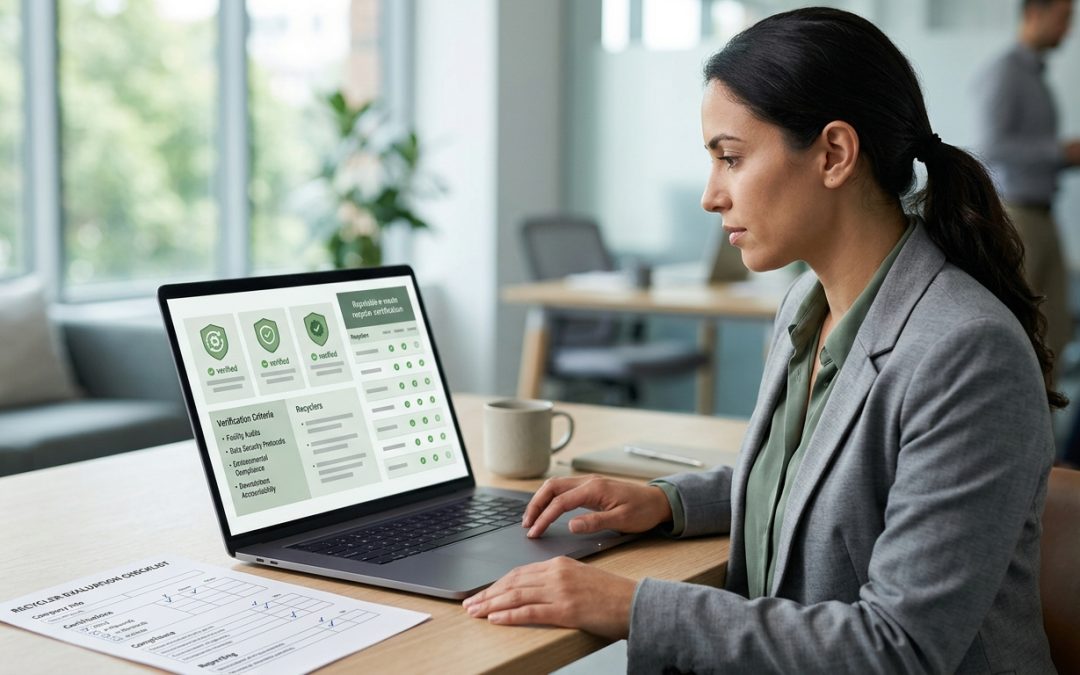
Why Choosing the Right Recycler Matters
Not all e-waste recyclers are created equal. While the majority of operators in Australia do the right thing, the industry does have its share of businesses that cut corners, whether that means dumping materials illegally, exporting waste to countries with weaker environmental protections, or failing to properly handle hazardous substances. Choosing a reputable recycler ensures your old electronics actually get processed responsibly rather than contributing to the problems recycling is supposed to solve.
For businesses, the stakes are even higher. Under Australian environmental legislation, the organisation that generates the waste can be held liable even after it’s handed to a third party. If your recycler dumps materials illegally, you could face regulatory consequences. And if devices contain sensitive data, handing them to an unvetted operator creates serious security risks.
Check for Relevant Certifications
Certifications are the most reliable starting point for assessing an e-waste recycler’s credibility. Legitimate operators invest in recognised certifications because they demonstrate compliance with established standards.
The key certifications to look for in Australia include AS/NZS 5377, which is the Australian and New Zealand standard specifically for the collection, storage, transport, and treatment of end-of-life electrical and electronic equipment. This is the most directly relevant certification for e-waste recycling in this region.
ISO 14001 covers environmental management systems. A recycler with ISO 14001 certification has a structured approach to managing environmental impacts and is subject to regular audits. ISO 27001 is relevant if data-bearing devices are involved, as it covers information security management. For data destruction specifically, look for alignment with NIST 800-88 guidelines.
- AS/NZS 5377 – Australian e-waste handling standard
- ISO 14001 – Environmental management system
- ISO 27001 – Information security management (for data-bearing devices)
- NIST 800-88 – Data sanitisation standard
- ADISA – Asset Disposal and Information Security Alliance (for data destruction)
Ask to see copies of current certificates, not just claims on a website. Legitimate operators will readily provide proof of their certifications and will have current, in-date documentation.
For more detail on the Australian standard, see our guide to AS/NZS 5377.
Ask About Their Processing Methods
A reputable recycler should be transparent about what actually happens to the materials they collect. Ask specifically where processing occurs and what the downstream chain looks like.
Key questions to ask include: Is the processing done on-site or sent to another facility? If sent elsewhere, where is that facility and what are their credentials? What percentage of materials is recovered versus sent to landfill? Do any materials get exported, and if so, to which countries and under what regulatory framework?
Be wary of operators who are vague about their processes or can’t explain their downstream chain. A recycler that collects your e-waste but then ships it to a developing country for unregulated processing is not providing responsible recycling, regardless of what their marketing says.
The best operators will be able to give you a clear breakdown of material recovery rates and destinations. They should be able to tell you, for example, that circuit boards go to a specific smelter for precious metal recovery, plastics go to a particular recycling facility, and batteries go through a dedicated lithium recovery process.
Visit the Facility If Possible
Nothing tells you more about a recycler than seeing their operation firsthand. Reputable operators welcome site visits and are proud to show how they work. If a recycler is reluctant to let you see their facility, that’s a significant red flag.
When visiting, look for a clean, organised operation with clear separation of different material streams. There should be appropriate safety equipment and practices in place. Storage areas should be contained and secure, particularly for batteries and hazardous materials. Staff should be wearing appropriate personal protective equipment.
Signs of a problematic operation include materials piled haphazardly with no apparent sorting, open-air storage exposed to weather, no visible safety protocols, and a general lack of organisation. These suggest an operator who is more interested in collecting fees than actually recycling properly.
Verify Their Chain of Custody Documentation
A proper chain of custody means you can trace what happened to your materials from the moment they left your hands to their final processing destination. This documentation is essential for compliance and provides proof that your e-waste was handled responsibly.
At minimum, a reputable recycler should provide a collection receipt or manifest detailing what was collected, a certificate of recycling or destruction once processing is complete, weight-based reporting showing what was received and what was recovered, and for data-bearing devices, individual asset-level reporting with serial numbers.
For businesses with compliance obligations, this documentation may be required for audit purposes. Environmental regulations increasingly expect waste generators to demonstrate that their waste was processed through legitimate channels. Having comprehensive chain of custody records protects you in the event of a regulatory inquiry.
Check Their Insurance and Licensing
E-waste recycling involves handling hazardous materials, operating industrial equipment, and managing environmental risks. Any recycler handling your e-waste should carry appropriate insurance and hold all necessary operating licences.
In most Australian states, e-waste processing facilities need specific environmental licences from the relevant state EPA (Environment Protection Authority). They should also carry public liability insurance, professional indemnity insurance, and workers’ compensation. For operators handling data-bearing devices, cyber liability insurance adds another layer of protection.
Ask for proof of insurance and check that their EPA licence is current and covers the types of materials they’re accepting from you. An operator running without proper licensing is operating illegally, and using them exposes you to risk.
Look at Their Track Record
Experience and reputation matter in this industry. Look for operators with an established track record and positive references from businesses similar to yours.
Check for reviews and testimonials, but also ask for direct references you can contact. A recycler who has been operating for several years and can provide references from established businesses is generally a safer choice than a new entrant with no track record.
It’s also worth checking whether the recycler has any history of environmental infringements or compliance issues. State EPA websites often publish enforcement actions, and a quick search can reveal whether an operator has been penalised for non-compliance.
Industry membership is another positive indicator. Members of industry bodies like the Australian Information Industry Association (AIIA) or participation in product stewardship schemes suggests a commitment to operating within established frameworks.
Understand Their Data Destruction Capabilities
If any of your e-waste contains data, which it almost certainly does if it includes computers, phones, printers, or storage devices, data destruction capability is non-negotiable. A recycler that handles data-bearing assets without proper data destruction processes is a data breach waiting to happen.
Ask about their data destruction methods. Do they offer software-based wiping that meets recognised standards like NIST 800-88? Do they provide physical destruction for devices that can’t be wiped? What verification process ensures every device has been sanitised? Do they provide individual certificates of data destruction with serial numbers?
For organisations subject to the Privacy Act or handling sensitive data, the data destruction process needs to be robust and fully documented. This is an area where cutting costs by choosing a cheaper operator can have severe consequences if a data breach results.
Our guide to data destruction for Australian businesses covers what to look for in detail.
Compare Pricing Transparently
E-waste recycling pricing varies significantly between operators, and the cheapest option is not always the best value. Some operators charge per kilogram, others per item type, and some offer flat-rate collections for business customers.
- Prices significantly below market rate (may indicate corners being cut)
- No transparency about what’s included in the price
- Extra charges for documentation or certificates that should be standard
- No clear pricing for data destruction as a separate line item
Get quotes from at least three operators and compare like for like. Make sure you understand what’s included: collection, transport, processing, data destruction, and documentation should all be clearly itemised. A slightly higher price from a certified, transparent operator is almost always better value than a bargain from an unknown quantity.
Making Your Decision
Choosing a reputable e-waste recycler comes down to verifiable credentials, transparency, and accountability. Certifications prove competence, site visits prove practice, documentation proves outcomes, and references prove consistency. Take the time to vet your recycler properly, because once your e-waste leaves your premises, the responsibility for what happens to it ultimately still reflects on you.
For more context on how the broader ITAD process works and where recycling fits in, explore our complete guide to ITAD.
EWV helps Victorian businesses manage e-waste and IT asset disposal compliantly and sustainably — including collection, certified data destruction, and recycling. Contact us for a free quote.