
Last updated: November 2026.
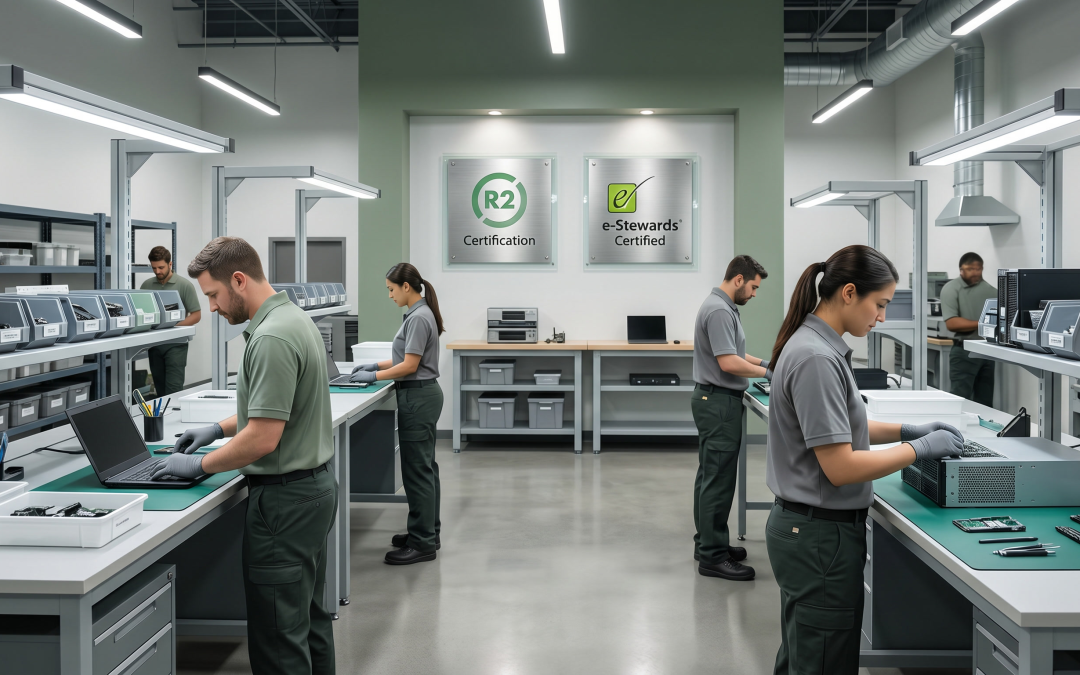
R2 and e-Stewards are the two best-known standards written specifically for the electronics reuse and recycling industry. Both aim to make sure end-of-life electronics are handled responsibly, but they approach the problem from different angles. This guide explains what each one covers, how they differ, and how they relate to the Australian standard, AS 5377:2022.
R2: Responsible Recycling Standard
R2 is administered by SERI (Sustainable Electronics Recycling International) and was developed through a multi-stakeholder process. The current version is R2v3. It is used internationally, with certified facilities in many countries, most of them in North America.
R2 covers several core areas. Environmental, health and safety requirements deal with managing hazardous materials, protecting workers from exposure and maintaining emergency response procedures. Data security requirements cover how data-bearing devices are received, stored, tracked and sanitised, with reference to recognised guidelines such as NIST SP 800-88.
Focus materials management addresses specific materials of concern in electronics, including lead, mercury, cadmium and other hazardous substances. Downstream vendor management is central to R2: facilities are expected to track where materials go after they leave and to check that downstream processors handle them appropriately.
R2 also includes requirements for legal compliance, quality management and facility security. Facilities are audited by accredited certification bodies.
e-Stewards
e-Stewards was developed by the Basel Action Network (BAN), an environmental organisation focused on preventing toxic trade and the export of hazardous waste to developing countries. That origin gives e-Stewards its particular focus on exports.
Its central rule is that hazardous e-waste is not to be exported to developing countries. Facilities working to e-Stewards commit to managing hazardous materials domestically or in countries with comparable protections, rather than shipping them to places with weaker environmental controls.
Beyond exports, e-Stewards covers environmental management, data security for data-bearing devices, worker health and safety, chain of custody and downstream accountability. It also prohibits the use of prison labour and the landfilling or incineration of hazardous e-waste.
BAN has also run GPS tracking studies, known as the e-Trash Transparency Project, which followed discarded electronics to see where they actually ended up.
Key Differences
R2 and e-Stewards share many objectives, but a few differences stand out. On exports, e-Stewards takes the stricter position. R2 allows export where the receiving facility meets set requirements and the export is legal, and it relies on downstream due diligence.
On scope, R2 places more emphasis on reuse, repair and remarketing alongside recycling. e-Stewards puts its emphasis on environmental protection and preventing harmful exports.
On adoption, R2 has more certified facilities worldwide. e-Stewards has a smaller base, concentrated in North America.
How They Relate to AS 5377:2022
In Australia, the standard written for the e-waste sector is AS 5377:2022, Management of electrical and electronic equipment for re-use or recycling. It replaced AS/NZS 5377:2013 and covers collection and storage, transport, preparation for re-use and treatment. Some Australian schemes and regulations refer to it, such as the National Television and Computer Recycling Scheme and Western Australia’s e-waste regulations.
R2 and e-Stewards are international standards and are much less common in Australia. They cover some of the same ground as AS 5377:2022, such as downstream accountability and data security, and are mainly relevant to organisations working with international clients or global procurement policies.
What These Standards Do Not Tell You
Knowing what R2 and e-Stewards cover is useful background, but a standard describes how an operation is meant to work. It does not tell you where your particular equipment will end up or what records you will receive. The most reliable way to assess any provider is to look at how they handle your equipment in practice.
Questions to ask any provider
- Are you lawfully authorised to receive and handle e-waste in Victoria?
- Where does our equipment go after collection, and who processes it downstream?
- What chain of custody records will we receive: serial numbers, weights, collection dates and the final destination of materials?
- How are data-bearing devices identified, stored and sanitised, and to which guideline?
- Will we receive a certificate of sanitisation for each data-bearing device?
A provider who answers these clearly, including naming their downstream processors and explaining what happens to any exported material, is showing you the kind of openness that both R2 and e-Stewards are designed to encourage.
Making Your Choice
When selecting an ITAD provider, it helps to understand what R2, e-Stewards and AS 5377:2022 each cover, so you can make sense of what providers say about their processes. If preventing exports is your main concern, the export questions above matter most. If you want equipment reused where possible, ask how devices are tested, refurbished and resold, and what records you receive for each one.
Planning an equipment disposal?
Our team’s processes are aligned with AS 5377:2022, and our data erasure follows NIST SP 800-88 Rev. 1 and IEEE 2883. You can request a quote for a collection or email info@ewastevictoria.net.au.