
Protecting Student Data Throughout the IT Lifecycle
Schools, universities, TAFEs, and registered training organisations manage extensive records about their students, including personal details, academic results, disciplinary records, financial information, and in many cases health and welfare data. When IT equipment in educational institutions reaches end of life, the data it contains must be destroyed in a way that protects student privacy and meets the sector’s specific regulatory requirements.
The education sector faces particular challenges around data destruction because of the diversity of IT equipment in use, the involvement of minors, and the intersection of education-specific legislation with broader privacy laws.
Regulatory Framework
Education sector data destruction is governed by several overlapping requirements. The Privacy Act 1988 (Cth) applies to private schools and universities with annual turnover above $3 million, though many smaller institutions are also covered through other mechanisms. State education legislation governs government schools, with each state having specific requirements. In Victoria, the Education and Training Reform Act 2006 and associated regulations set requirements for student record management.
The Australian Qualifications Framework (AQF) and standards set by regulatory bodies such as ASQA (Australian Skills Quality Authority) and TEQSA (Tertiary Education Quality and Standards Agency) include requirements for record keeping and management that affect when and how student data can be destroyed.
For institutions that enrol international students under CRICOS (Commonwealth Register of Institutions and Courses for Overseas Students), the Education Services for Overseas Students (ESOS) Act 2000 and the National Code of Practice impose additional record-keeping obligations.
Retention Requirements
Education records must be retained for specified periods before destruction can occur. Student enrolment and academic records typically need to be retained for a minimum of 30 years under state education authority requirements, or permanently in some cases. Financial records related to student fees and funding must be kept for seven years under the Corporations Act and tax legislation. CRICOS-related records for international students must be retained for two years after the student ceases to be an accepted student.
Research data at universities may be subject to specific retention requirements set by funding bodies. ARC and NHMRC funded research typically requires data retention for five years after publication. Ethics committee records may need to be retained for specified periods after the completion of the research project.
Given these varying retention periods, institutions must carefully assess which records reside on any IT equipment before approving it for data destruction.
Types of Education IT Equipment
Educational institutions deploy a wide variety of IT equipment that may contain student data. Student information systems (SIS) and learning management systems (LMS) servers store comprehensive student records. Classroom computers and labs may contain student work, login credentials, and cached data from online platforms. Teacher and staff laptops hold student assessments, reports, and communications with parents.
School-issued student devices (where 1:1 device programs are in place) may contain student work, browsing history, and application data. Library systems store borrowing records linked to student identifiers. Security cameras and access control systems capture images of students and log their movements. And specialised equipment in vocational training (CNC machines, automotive diagnostics, hospitality systems) may store student assessment data.
Special Considerations for Minor Students
Schools that serve children and young people have heightened responsibilities around data protection. Student data for minors is considered sensitive information under privacy law, and the consequences of a data breach involving children’s information are particularly serious.
When disposing of IT equipment from schools, pay special attention to devices that may contain photographs or videos of students (from school events, classroom activities, or security cameras), student welfare records including counselling notes and mandatory reporting documentation, special needs and disability support records, and behavioural and disciplinary records.
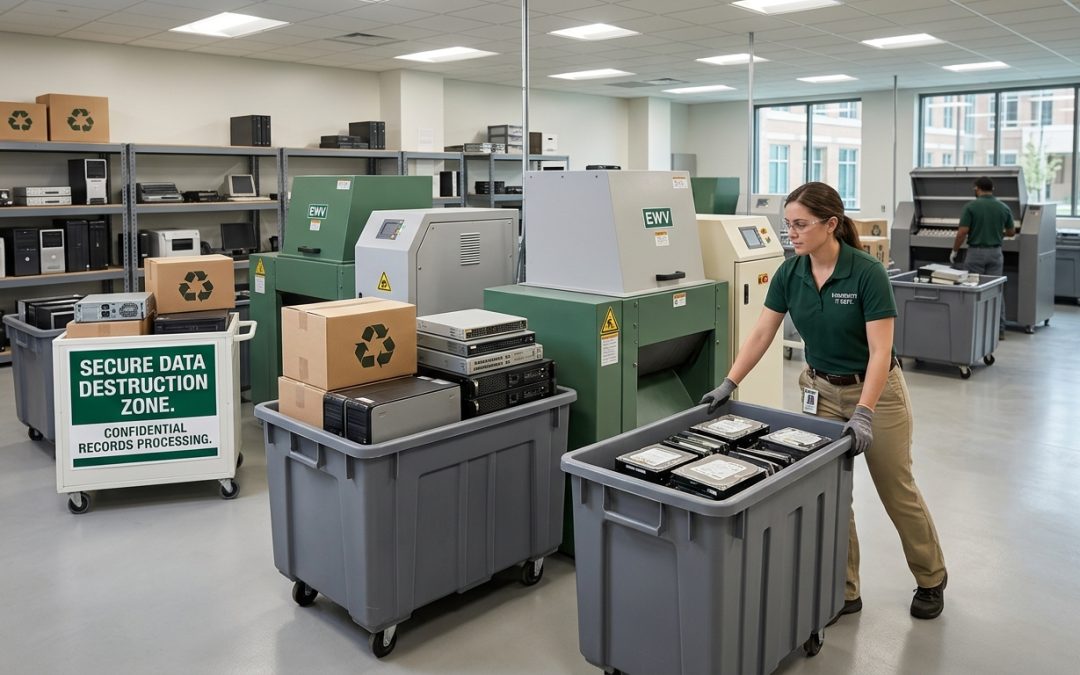
Physical destruction of storage media is recommended for equipment that contained these particularly sensitive categories of student data.
University Research Data
Universities face additional data destruction challenges related to research data. Research computing equipment, including high-performance computing nodes, data storage arrays, and laboratory computers, may contain research datasets that are subject to ethics approvals, funding body requirements, intellectual property protections, or commercial confidentiality agreements.
Before disposing of research computing equipment, verify that all research data has been archived in accordance with the relevant ethics approval, funding agreement, and university research data management policy. Ensure that any commercially sensitive research data or IP is properly sanitised using NIST 800-88 compliant methods.
BYOD and Shared Device Challenges
Many educational institutions operate Bring Your Own Device (BYOD) programmes or use shared devices in classrooms and libraries. When shared devices are replaced, they may contain data from dozens or hundreds of different students who used them over their lifetime. Cached login credentials, browser history, downloaded files, and application data from all of these users may reside on the device.
For school-owned shared devices, perform a thorough data sanitisation before disposal. For BYOD programmes where the devices are student-owned, provide guidance to students and parents about sanitising devices when they leave the school or upgrade equipment.
Compliance with the AS/NZS 5377 Standard
Education institutions in Victoria must comply with the state’s e-waste landfill ban, which means IT equipment cannot be disposed of in general waste. Using a certified e-waste processor that complies with AS/NZS 5377 ensures both data destruction and environmental compliance. This dual requirement makes it essential to select a disposal provider that can meet both data security and environmental standards.
Education institutions have a special responsibility to protect student data, particularly the data of children and young people. Building robust data destruction practices into IT lifecycle management honours that responsibility and demonstrates the institution’s commitment to student welfare.
EWV provides NIST 800-88 certified data destruction for Victorian businesses, covering software-based erasure and physical destruction with full chain-of-custody documentation. Request a quote to discuss your requirements.