
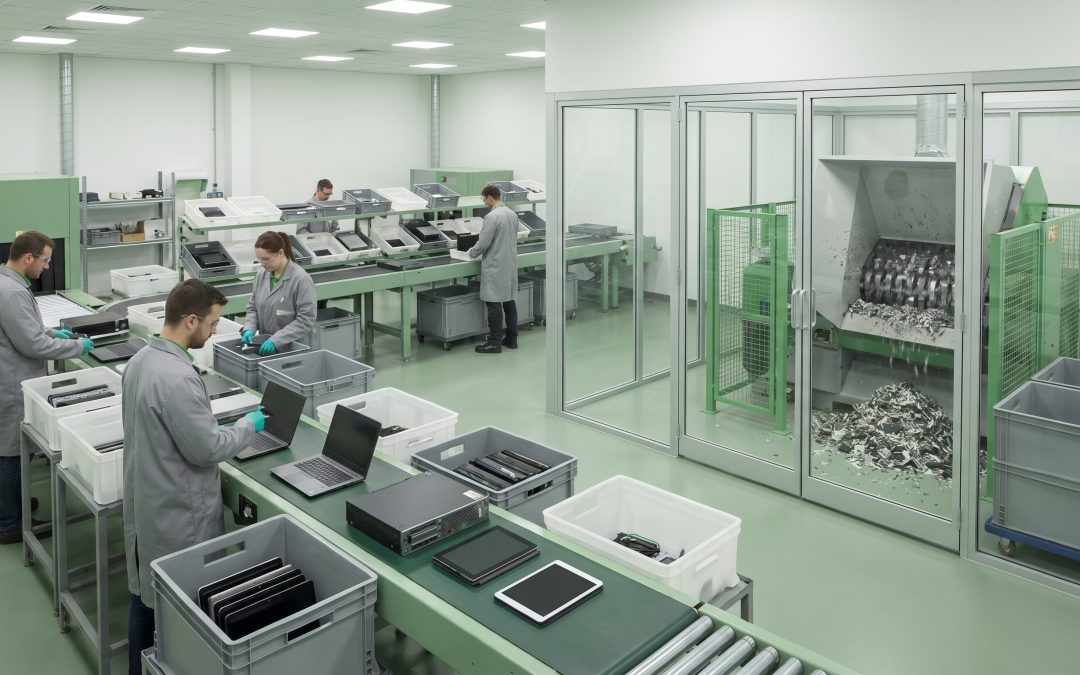
When organisations begin outsourcing their IT asset disposition, one of the first decisions they face is whether to work with a full-service ITAD provider or engage specialist providers for individual parts of the process. Both approaches have legitimate advantages, and the right choice depends on factors like volume, complexity, and internal capability.
What Full-Service ITAD Providers Offer
A full-service ITAD provider manages the entire lifecycle of retired IT equipment under a single contract. This typically includes collection and logistics, data destruction, testing and grading, refurbishment, remarketing, recycling of non-functional items, and reporting and compliance documentation. The value proposition is simplicity. You deal with one vendor, one invoice, and one point of accountability. For organisations with limited internal resources to manage multiple vendor relationships, this model reduces administrative overhead significantly.
Full-service providers also tend to offer better visibility across the entire disposition chain because they control each step. When something goes wrong, there is no finger-pointing between vendors about whose responsibility it was.
What Specialist Providers Offer
Specialist providers focus on one particular area of the ITAD process. You might work with a dedicated data destruction company for wiping and shredding, a refurbishment specialist for extending asset life, a logistics company for secure transport, and a commodity recycler for materials recovery. The argument for specialists is depth of expertise. A company that does nothing but data destruction all day may have more refined processes, more certifications, and more experience with edge cases than a generalist provider handling data destruction as one of ten services.
In highly regulated industries like finance, healthcare, or government, this depth of specialisation can be the deciding factor, particularly for data destruction where the consequences of failure are severe.
Cost Considerations
Full-service providers may offer bundled pricing that appears more competitive on paper. However, the total cost depends heavily on your asset mix. If most of your retired equipment has strong resale value, a specialist remarketing firm might return significantly more revenue than a generalist provider because they have deeper relationships with secondary market buyers in specific equipment categories.
Conversely, if your volumes are relatively small and your equipment mix is varied, the overhead of managing three or four specialist relationships, each with minimum fees and separate logistics arrangements, can quickly exceed what a full-service provider would charge.
Risk and Compliance
From a compliance perspective, full-service providers simplify your audit trail. One vendor means one set of certifications to verify, one contract to manage, and one chain of custody to document. This is particularly relevant for organisations required to demonstrate compliance with standards like AS/NZS 5377 or NIST 800-88.
With multiple specialists, you need to ensure every provider in the chain meets your compliance requirements. A gap at any point, for example a transport company without adequate security protocols, can compromise the integrity of the entire disposition process.
That said, some organisations deliberately separate data destruction from other ITAD activities so that no single vendor has both access to data-bearing assets and control of the disposition process. This separation of duties can actually strengthen your security posture.
Scalability and Flexibility
Full-service providers generally scale more easily because they can allocate resources across their service lines. If you have a sudden office decommission or a large refresh project, one call can set the entire process in motion.
Specialist arrangements offer more flexibility in terms of switching providers. If your remarketing partner is not achieving the returns you expected, you can replace them without disrupting your data destruction or recycling workflows. With a full-service provider, dissatisfaction with one service line often means renegotiating the entire contract or accepting uneven performance across services.
When to Choose Full-Service
A full-service model tends to work best for mid-market organisations processing moderate volumes of mixed IT equipment, companies with small IT teams that cannot manage multiple vendor relationships, organisations prioritising simplicity and single-point accountability, and businesses with standard compliance requirements that do not demand ultra-specialised capabilities.
When to Choose Specialists
A specialist approach tends to work best for large enterprises with the internal resources to manage multiple vendors, organisations in highly regulated industries where data destruction must meet the highest possible standards, companies with high-value equipment where specialist remarketing can significantly increase returns, and businesses with specific geographic or logistical requirements that no single provider can meet nationally.
The Hybrid Approach
Many organisations land somewhere in between. A common hybrid model uses a full-service provider for day-to-day ITAD operations while engaging a specialist data destruction company for the most sensitive assets. This gives you the administrative simplicity of a single primary vendor while ensuring your highest-risk items receive specialised treatment.
Another hybrid approach is to use a full-service provider as the primary coordinator but require them to subcontract specific services to approved specialists. This preserves single-point accountability while still accessing specialist expertise. Just make sure your contract clearly defines subcontracting rights and that you have visibility into who is actually handling your assets.
For a broader overview of how to evaluate ITAD providers against your specific requirements, see our guide on how to choose an ITAD provider in Australia.
]]>